
Bank Nifty Budget Session Strategy | Trade Volatility with Structure
Learn a professional Bank Nifty budget session strategy designed to handle volatility with defined risk. A structured options approach for serious traders.
Every year, the Union Budget turns Bank Nifty into one of the most volatile instruments in the Indian market.
Prices move fast. Headlines create noise. Emotions run higher than logic.
For most traders, the budget session becomes a gamble disguised as a trading opportunity. Direction is guessed. Options are bought at inflated premiums. Stops are ignored. And when volatility collapses, capital follows.
At Replete Equities, we approach the Bank Nifty budget session very differently.
We don’t trade the budget to feel excitement.
We trade it to manage volatility, protect capital, and stay aligned with a long-term trading process.
This article explains a Bank Nifty options strategy for the budget session that is designed to work in uncertain, high-volatility conditions—without relying on prediction.
Why the Budget Session Is Difficult to Trade in Bank Nifty
Bank Nifty reacts sharply during budget week because it sits at the intersection of policy, banking reforms, government spending, and macro expectations.
Volatility starts rising days before the budget. Option premiums become expensive. Traders expect a “big move,” but the market often changes direction multiple times before settling.
What makes the budget session dangerous is not the movement itself, but the lack of clarity. A strong first reaction is frequently reversed. A quiet opening can explode later in the day. This is where directional trading becomes emotionally draining.
Professional traders accept one simple truth during the budget week:
Direction is uncertain, but volatility is guaranteed.
That is exactly what this strategy is built around.
The Core Objective of This Bank Nifty Budget Strategy
This strategy is not designed to predict whether Bank Nifty will go up or down after the budget.
Its purpose is to structure a position that can absorb volatility, benefit from time decay, and remain protected against sudden, unexpected moves.
The focus is on predefined risk, controlled exposure, and psychological comfort—especially during fast markets.
Instead of reacting to news ticks, the trader lets the structure do the heavy lifting.
Understanding the Strategy Structure in Simple Terms
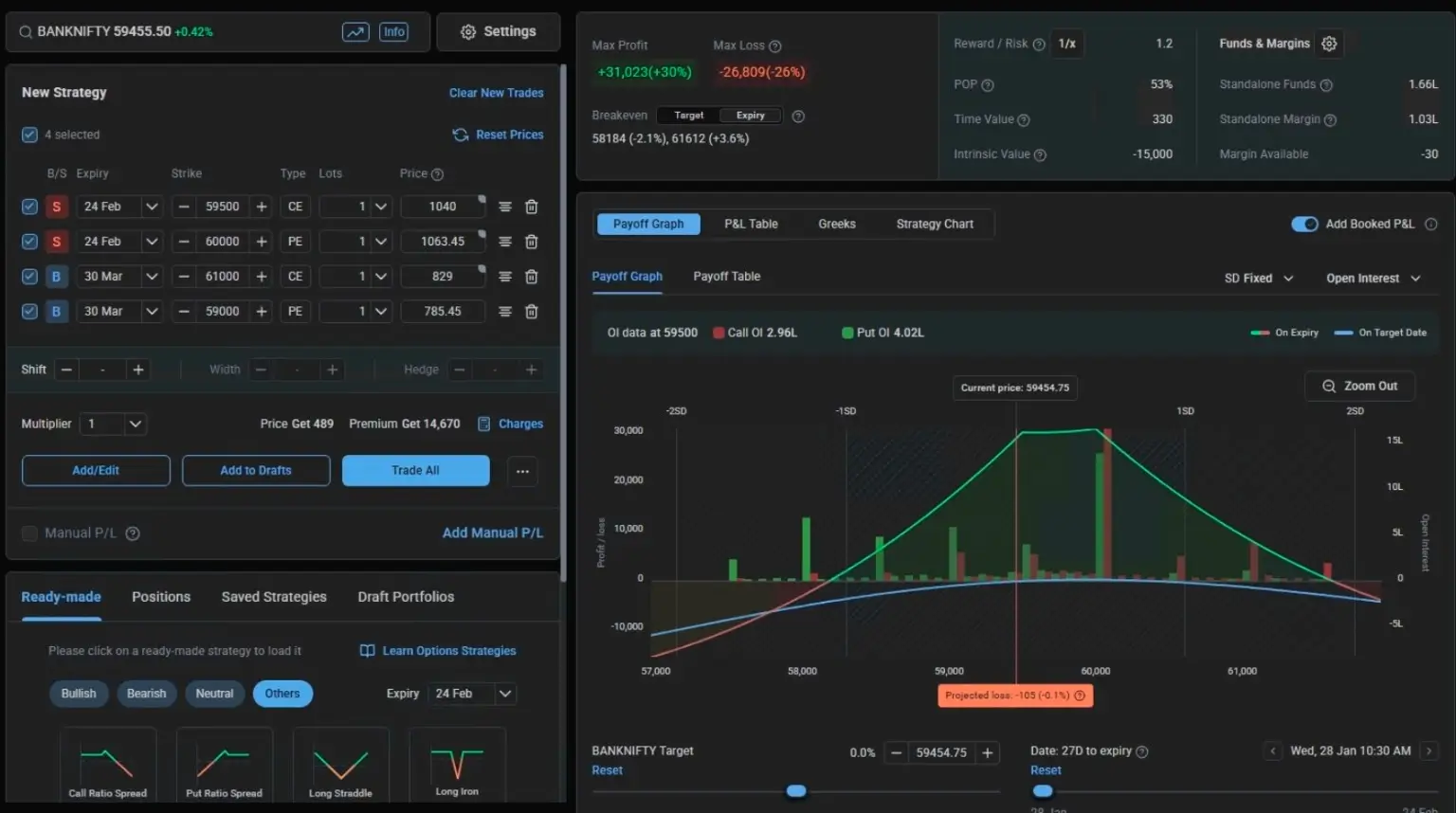
The strategy combines short-term option selling with longer-duration option buying.
Near-expiry options are sold to take advantage of elevated premiums during the budget week. These options lose value quickly as time passes, especially if price stays within a broad range.
At the same time, far-expiry options are bought as protection. These hedges ensure that even if Bank Nifty makes a sharp move on budget day, the loss remains capped.
This creates a balance.
Income is generated from time decay, while risk is controlled through longer-term hedges. The trader is no longer exposed to unlimited downside or panic-driven exits.
Why This Works Well During the Budget Session
During budget weeks, implied volatility is already high. Retail traders often pay a premium to buy options, hoping for a breakout.
This strategy flips that behaviour.
By selling options when fear is high and protecting the position with hedges, the trader positions themselves on the probability side of the trade, not the prediction side.
Even if Bank Nifty moves, the structure has enough breathing room to handle noise. And if the market consolidates after the event—as it often does—the decay in near-expiry options works in favour of the trader.
Risk Management: The Real Edge in Budget Trading
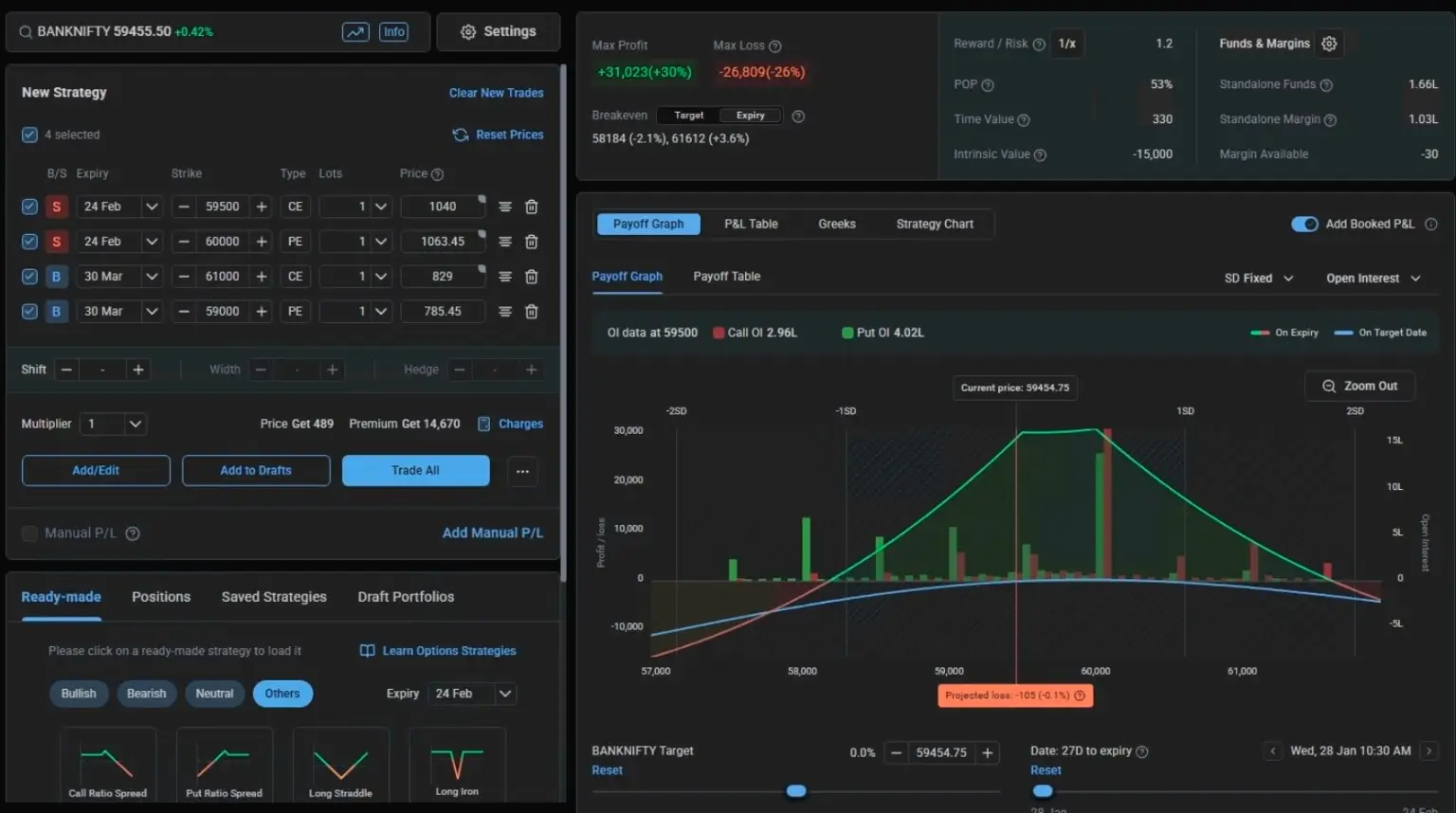
One of the most important aspects of this Bank Nifty budget session strategy is that the maximum loss is known in advance.
There are no surprises.
There is no emotional averaging.
There is no “hoping it comes back.”
This is how professional traders survive high-impact events year after year.
They don’t ask, “How much can I make?”
They ask, “How much am I willing to lose if I’m wrong?”
Once that question is answered, trading becomes calm and repeatable.
Who Should Consider This Strategy
This strategy is suitable for traders who want to participate in the budget session without exposing their capital to unnecessary risk.
It works well for option sellers who are uncomfortable with naked positions, and for experienced traders who understand that longevity matters more than one big day.
It is not designed for traders looking for lottery-style returns or aggressive directional bets. The strength of this strategy lies in discipline, not excitement.
A Realistic Perspective from Market Experience
Every budget creates new stories. Some traders make money. Many quietly disappear.
The traders who survive long-term are not the ones who guessed the direction correctly once. They are the ones who respected volatility, sized their positions sensibly, and traded with structure.
At Replete Equities, this philosophy is non-negotiable.
We focus on alignment between capital, temperament, and strategy. Budget sessions are treated as events to be managed, not opportunities to prove intelligence.
Final Thoughts: Trade the Budget Like a Professional, Not a Speculator
The Union Budget is not a one-day opportunity.
It is a stress test of your trading process.
Most traders don’t lose money on budget day because the market moves too much. They lose money because they enter the event without structure, without clarity, and without knowing how much risk they are truly carrying.
A well-designed Bank Nifty budget session strategy is not about predicting the announcement or reacting to news flashes. It is about staying positioned when volatility rises, remaining protected when emotions peak, and exiting the event with capital—and confidence—intact.
This strategy reflects the same philosophy we follow at Replete Equities:
risk first, structure always, and alignment above all else.
If you want to go beyond copying strategies and actually learn how to build, adjust, and manage such option structures on your own, we invite you to take the next step.
👉 Ready to Trade with Structure and Clarity?
Explore our Option Strategies Mentorship Program, where we work closely with traders to help them:
- Understand volatility-driven strategies
- Build hedged option structures for events like budgets and results
- Develop a repeatable, risk-managed trading process
📞 Book a 1:1 Strategy Call to see whether structured options trading aligns with your capital and temperament.
💬 Or contact us on WhatsApp at +91-7229945555 to start the conversation.
Because long-term success in trading doesn’t come from one big budget day.
It comes from making disciplined decisions, year after year.
Disclaimer & Risk Disclosure
The information provided on this website and in this article is strictly for educational and informational purposes only and should not be construed as investment advice, trading advice, or a recommendation to buy or sell any securities or derivatives.
Trading and investing in the stock market, especially in derivatives such as options, involves substantial risk and may not be suitable for all investors. Market conditions, volatility, liquidity, and individual risk tolerance can significantly impact outcomes. Past performance of any strategy or market movement is not indicative of future results.
The strategies discussed, including the Bank Nifty budget session strategy, are examples of structured approaches and do not guarantee profits or protection against losses. Readers are advised to evaluate their own financial situation, risk appetite, and trading experience before taking any market positions.
Replete Equities, its founders, partners, associates, or employees shall not be responsible for any losses incurred as a result of decisions made based on the information presented on this website or related communication channels.
Users are strongly encouraged to consult with a SEBI-registered investment adviser or financial professional before making any investment or trading decisions.
By accessing and using this content, you acknowledge that you understand the risks involved in trading and investing in the financial markets and agree that all trading decisions are made at your own discretion and responsibility.

Comments ()