
Before You Change Your Trading Strategy, Ask This | Alignment in Trading
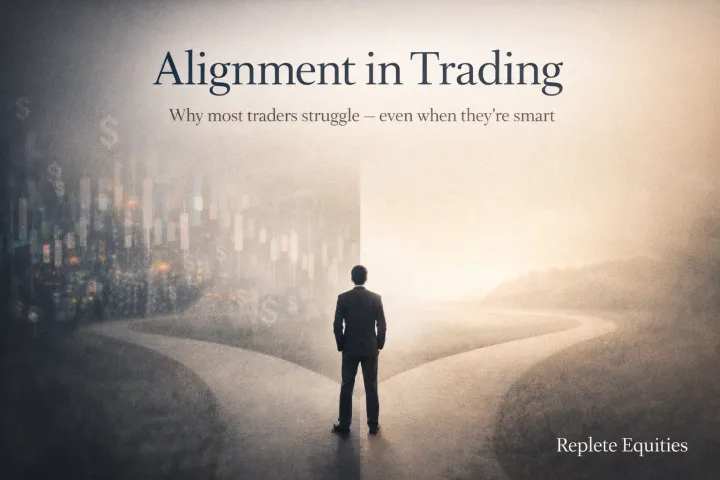
Before switching strategies, most traders skip a critical question. This article explains why choosing the right market role matters more than tactics. Article 3 of the Alignment in Trading series.

Most traders respond to discomfort in the same way.
When results disappoint, when confidence drops, or when emotions start to interfere, the instinctive reaction is to change strategies. A new setup feels like progress. A different framework offers hope.
Very few traders pause to ask a more important question.
Is the problem the strategy or the role I’m trying to play in the market?
Markets Don’t Require One Kind of Participant
Markets allow many ways to participate.
Some approaches demand frequent decisions, constant attention, and fast emotional recovery. Others require patience, delayed feedback, and the ability to remain inactive for long periods.
Neither approach is better than the other.
Problems begin when expectations don’t match the role being played.
When Expectations Create Hidden Stress
Stress in trading often doesn’t come from losses alone.
It comes from expecting:
- fast results from slow approaches
- emotional calm from high-frequency decisions
- certainty from probabilistic outcomes
When expectations are misaligned, even small drawdowns feel overwhelming. Confidence weakens not because results are poor, but because the experience feels wrong.
The Question Most Traders Skip
Instead of asking, “Which strategy should I use?”, it’s often more useful to ask:
- What kind of market participant am I built to be?
This question shifts the focus from tactics to identity.
Identity drives behaviour far more reliably than rules or indicators ever will.
Why Role Matters More Than Strategy
When the role fits:
- discipline feels natural rather than forced
- patience feels possible rather than painful
- losses feel tolerable rather than personal
When it doesn’t:
- rules feel restrictive
- emotions dominate decisions
- every mistake feels like a reflection of self-worth
No strategy can fix a role mismatch.
How Misalignment Shows Up Over Time
Misalignment rarely appears immediately.
It shows up gradually as:
- increasing hesitation
- emotional fatigue
- constant second-guessing
- reliance on external opinions
These are not signs of incompetence.
They are signals that the role you’re playing may not suit you.
A Practical Reflection
Before making your next major change, write down honest answers to these questions:
- How much time can I consistently give to markets?
- How do I emotionally respond to losses?
- Do I prefer defined outcomes or open-ended uncertainty?
- Does my current approach demand behaviour I have to force?
These answers reveal more than any backtest.
When Alignment Is Right
When you choose a role that fits:
- decision-making becomes calmer
- learning integrates more naturally
- drawdowns feel manageable
- confidence grows quietly
You stop trying to control markets.
You start managing yourself.
A Closing Thought
You don’t need more exposure, more strategies, or more opinions.
You need clarity about how you participate.
When that’s clear, the right approaches become obvious.
A resource, if this resonates
If you want a structured way to reflect on your role in the market before changing strategies, I’ve put together a short clarity framework called “Which Kind of Trader Are You?”.
It’s not a trading system and it doesn’t offer shortcuts.
It’s designed to help you think clearly about alignment before action.
You can find it here: 👇
Read it only if clarity feels more valuable than speed.
Author’s Note
I’ve spent years observing traders across different market cycles - not just how they trade, but how they think, react, and adapt when things don’t go as planned.
What stood out wasn’t a lack of intelligence or effort.
It was how often capable people struggled because the way they participated in markets didn’t match who they were.
These articles aren’t meant to provide answers or strategies.
They’re meant to slow the conversation down - just enough to ask better questions.
If any of this resonates, take it as an invitation to reflect, not rush.
Clarity tends to compound better than activity.
- Sachin Sival
Founder, Replete Equities
Writing about market behaviour, alignment, and sustainable decision-making

Comments ()