
ChatGPT for Stock Market Analysis in India (2026)
How Professional Traders Use AI for Smarter Market Decisions? Updated for Indian Markets | Traders • Investors • Options Participants

The Indian stock market has changed dramatically in the last few years.
Retail participation is at record highs.
F&O volumes are exploding.
Information is everywhere — but clarity is rare.
Most traders today don’t lose money due to lack of data.
They lose money due to poor decision-making frameworks.
This is where ChatGPT and AI-driven market analysis are quietly changing how serious traders and investors operate.
At Replete Equities, AI is not used to predict markets — it is used to analyse structure, assess risk, and reduce emotional errors.
This article explains how ChatGPT can be used for Indian stock market analysis, what most traders do wrong, and how a structured AI Market Analysis Playbook can become a serious edge.
⚠️ Disclaimer: This article is for educational and analytical purposes only. It does not provide buy/sell recommendations or investment advice.
Why Most Traders Use ChatGPT the Wrong Way
A quick look at common search queries like “ChatGPT stock tips India”, “AI trading signals”, or “Best ChatGPT prompts for intraday trading” reveals a clear pattern — most traders are hunting for shortcuts. They expect AI to replace thinking, discipline, and process. That mindset is not just flawed; it’s risky.
ChatGPT is not designed to act as a signal generator or prediction engine. When used that way, it amplifies randomness rather than reducing it. The real power of AI emerges only when it is positioned correctly within a trader’s decision framework.
Used intelligently, ChatGPT functions best as:
- A market analysis assistant
- A risk-awareness and scenario-mapping tool
- A decision-support system, not a decision-maker
This distinction separates professional usage from retail misuse.
ChatGPT for Stock Market Analysis in India: The Right Approach
When applied with structure and intent, ChatGPT becomes a powerful analytical companion. It helps traders move away from reactive trading and towards context-driven decision-making.
Instead of asking “what to trade,” professionals use AI to understand “what kind of market they are operating in.” This shift alone dramatically improves consistency.
Used correctly, ChatGPT supports traders by helping them:
- Analyse market regimes
- Interpret volatility and risk conditions
- Understand institutional behaviour
- Stress-test portfolios and scenarios
- Reduce emotional and impulse-driven trades
This mirrors how desks, funds, and seasoned professionals approach markets — process first, execution second.
Key Areas Where ChatGPT Adds Real Value
1. Market Structure & Regime Analysis
One of the most powerful uses of ChatGPT lies in understanding market context, not market direction. AI can synthesise multiple inputs to paint a clear structural picture.
It can assist in analysing:
- Nifty 50 and Bank Nifty structure
- India VIX behaviour
- Market breadth and participation
- FII and DII flow dynamics
The outcome isn’t a signal — it’s clarity. It helps answer the most important question every trader should ask before deploying capital:
What kind of market are we trading in right now?
2. Technical Structure (Beyond Indicators)
Most traders rely heavily on indicators, often without understanding underlying structure. This is where AI adds depth.
Instead of chasing signals, ChatGPT can help analyse:
- Multi-timeframe alignment
- Trend maturity and exhaustion
- False breakouts vs genuine acceptance
- Rejection and absorption at key levels
This structural lens significantly reduces whipsaws and overtrading, especially during choppy or transition phases.
3. Risk & Portfolio Exposure Analysis
Risk analysis is one of the most underrated — and underused — applications of ChatGPT. While opportunity is visible, risk is often hidden.
AI can help traders assess:
- Concentration and exposure imbalance
- Correlation risk across positions
- Drawdown vulnerability
- Event-day and overnight exposure
At Replete Equities, risk analysis always precedes opportunity analysis. Capital protection is not optional — it’s foundational.
4. Options & Volatility Analysis (India-Specific)
For index options traders, especially those operating in weekly expiries, AI can be extremely valuable when used with discipline.
ChatGPT can assist in understanding:
- Volatility regimes and transitions
- Greeks interaction under changing conditions
- Time decay behaviour across structures
- Structural risks embedded in weekly expiries
This is particularly powerful for delta-neutral and hedged strategies, where risk management matters more than direction.
5. Macro & Event Risk Interpretation
Markets don’t move in isolation. Events shape volatility, liquidity, and behaviour — often before price reacts.
ChatGPT helps traders break down:
- RBI monetary policy impact
- Budget and policy-driven volatility patterns
- Global-to-India risk transmission
- Liquidity cycles and systemic stress points
Instead of reacting emotionally to headlines, traders learn to anticipate risk zones and adjust exposure proactively.
Why Generic ChatGPT Prompts Don’t Work
Most online content promotes prompts like:
- “Tell me which stock to buy”
- “Predict Nifty tomorrow”
- “Best intraday stock today”
These prompts may sound convenient, but they are fundamentally flawed.
They:
❌ Produce unreliable and inconsistent outputs
❌ Encourage shortcut-driven thinking
❌ Undermine basic risk discipline
Professional traders don’t ask AI to predict markets.
They use analysis-grade prompts to understand structure, risk, and context — and that difference defines long-term survival.
How Professional Traders Use ChatGPT for Market Analysis?
Most articles talk about ChatGPT.
Very few show how it is actually used by serious traders.
Below are 4 real analysis prompts taken directly from the AI Market Analysis Playbook.
These are not tips, not predictions, and not trading signals.
They are designed to help traders understand market structure, risk, and context — the same way professionals do.
🔍 1. Indian Market Regime Analysis (Index-Level Clarity)
Act as a professional Indian market analyst.

Analyse the current structure of the Indian equity market using:
- Nifty 50 and Bank Nifty price structure
- India VIX behaviour
- Market breadth and participation
- Recent FII and DII flow trends

Assess:
- Whether the market is trending, balancing, or transitioning
- The current risk environment

Constraints:
- No buy/sell recommendations
- No forecasts or price targets

Output:
- Market regime classification
- Structural risks
- Key variables to monitor
👉 This prompt answers the most important question traders ignore:
“What kind of market are we actually in?”
🔍 2. Multi-Timeframe Technical Structure Analysis
Act as a technical structure analyst.

Analyse [stock/index] across weekly and daily timeframes.

Assess:
- Trend alignment or conflict
- Structural integrity of price
- Signs of accumulation or distribution

Constraints:
- No entry, exit, or target levels

Output:
- Structure summary
- High-risk zones
👉 This prevents traders from trading lower-timeframe noise against higher-timeframe risk.
🔍 3. Portfolio Risk Exposure Analysis
Act as a portfolio risk analyst.

Analyse the risk exposure of a portfolio with:
[allocation details]

Assess:
- Concentration risk
- Correlation risk
- Drawdown vulnerability during a 10–15% market correction

Constraints:
- No rebalancing or allocation advice

Output:
- Risk summary
- Hidden vulnerabilities
👉 Most traders analyse profits.
Professionals analyse survival first.
🔍 4. Options Market Risk Profile (No Strategies)
Act as a derivatives risk analyst.

Analyse the current options market environment for [Nifty/Bank Nifty].

Assess:
- Volatility regime
- Greeks interaction
- Time decay behaviour

Constraints:
- No strategy recommendation

Output:
- Risk profile
- What is already priced into option premiums
👉 This single prompt can save option traders from invisible volatility and gamma traps.
Important:
These are analysis prompts, not execution tools.
They help traders think clearly, not trade blindly.
If 4 prompts can change how you look at the market, imagine what a complete, structured playbook can do.
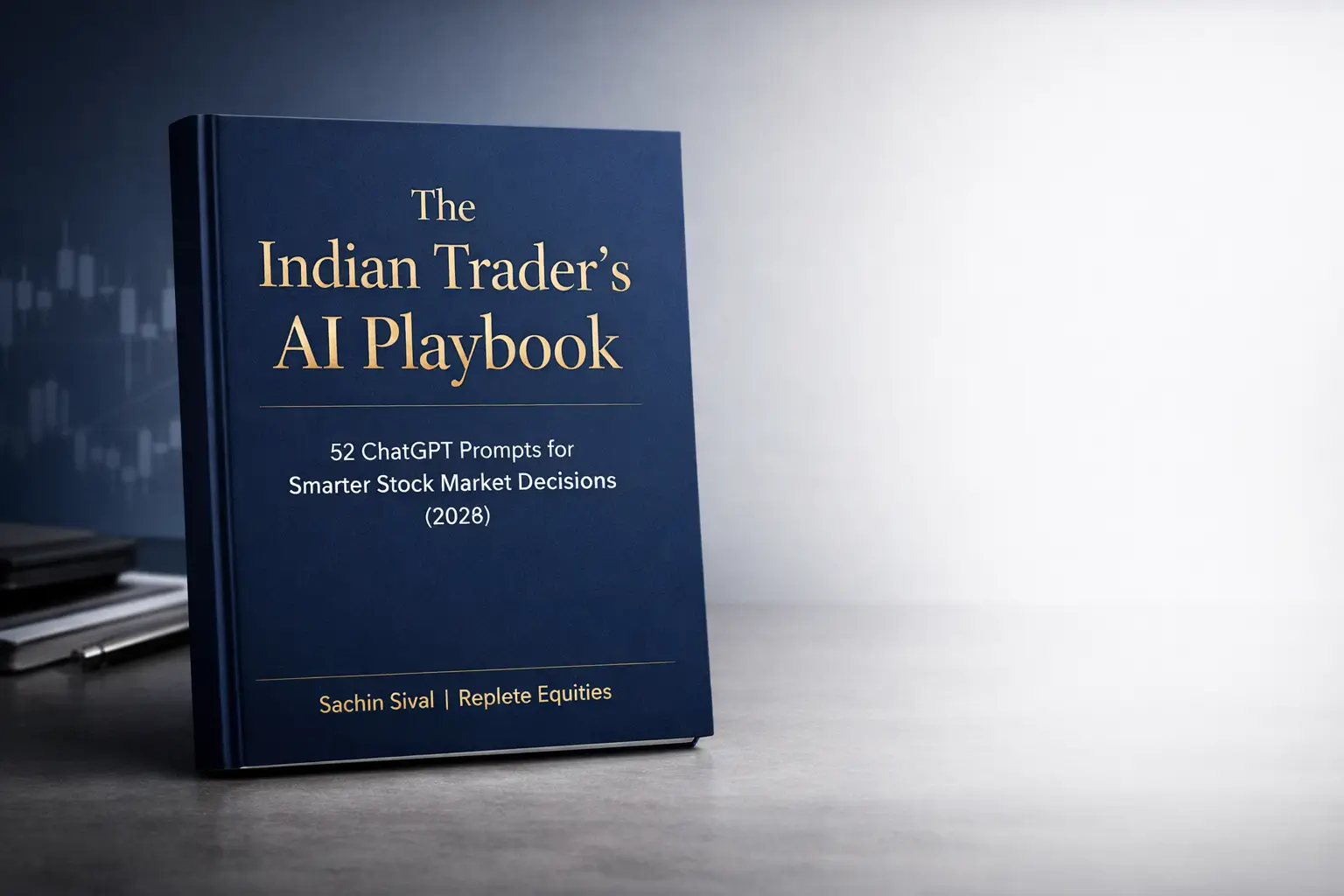
Introducing the AI Market Analysis Playbook (2026)
Most traders don’t need more indicators.
They need better decision-making frameworks.
That’s exactly why Replete Equities created:
📘 The AI Market Analysis Playbook for Indian Traders & Investors
This is a professional-grade resource, built to help you:
- Analyse market regimes before trading
- Understand risk before opportunity
- Read volatility instead of reacting to it
- Avoid emotional and structural mistakes
- Use ChatGPT like a research assistant, not a tip machine
What You Get Inside the Playbook
✔ 52 institutional-style AI analysis prompts
✔ Market structure & regime frameworks
✔ Technical & price-structure analysis
✔ Portfolio & drawdown risk assessment
✔ Options & volatility risk analysis
✔ Macro, RBI & event-risk interpretation
All prompts are:
- Copy–paste ready
- India-specific
- SEBI-safe
- Designed for real-world decision support
Who This Playbook Is For
✅ Traders who want consistency, not excitement
✅ Investors who respect risk
✅ Options traders tired of random losses
✅ Professionals who want structure over noise
❌ Not for tip seekers or shortcut hunters
📥 How to Get Access
👉 Option 1:
Click on below link and instant download the "AI Playbook": 👇

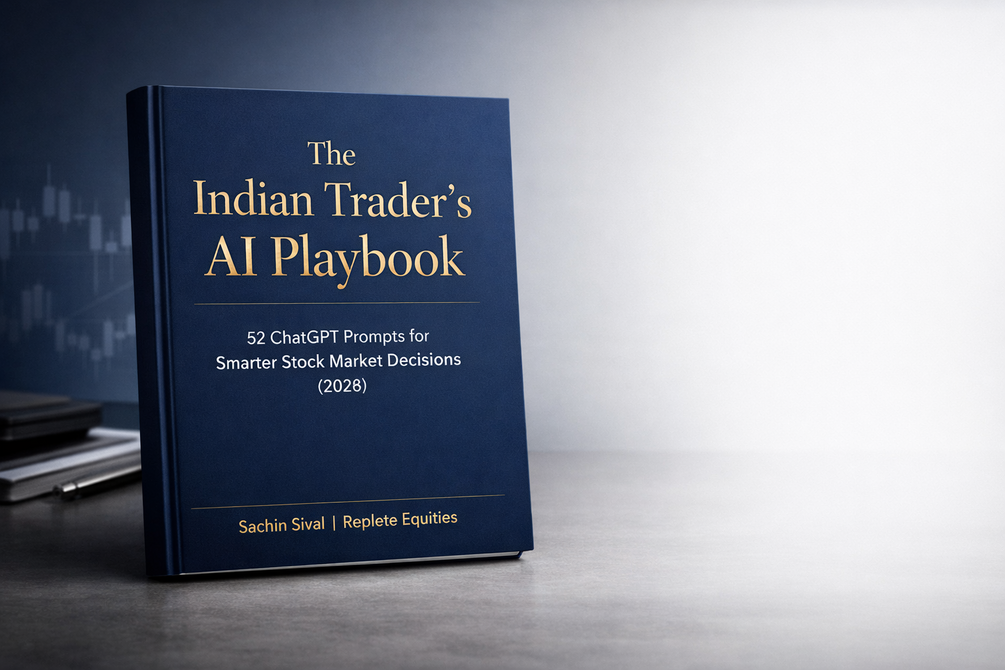
👉 Option 2:
Contact Replete Equities on WhatsApp: +91-7229945555
We’ll guide you on how to use the playbook correctly based on your experience level.
Final Note
Markets don’t reward intelligence.
They reward discipline, structure, and risk awareness.
AI doesn’t replace that -
It strengthens it when used correctly.
—
Sachin Sival
Founder, Replete Equities
Risk-managed trading | Market structure | AI-assisted analysis
⚠️ Disclaimer: This article or AI Playbook mentioned in this article, is for educational and analytical purposes only. It does not provide buy/sell recommendations or investment advice.


Comments ()