
Iron Butterfly Strategy in HDFCBANK: A Structured Options Approach for Range-Bound Markets
Learn how the Iron Butterfly strategy in HDFCBANK can help traders approach expiry with defined risk, time decay benefits, and structured execution.

Many traders enter expiry sessions with strong opinions about market direction, volatility, or last-minute price movement. However, experienced options traders often approach expiry differently. Instead of relying on predictions, they use structured strategies designed around probabilities, risk control, and market behavior.
One such strategy is the Iron Butterfly, which can be particularly useful when a stock such as HDFCBANK is expected to remain near a defined price zone into expiry.
Rather than buying options impulsively or selling premium without protection, the Iron Butterfly offers a disciplined framework with predefined risk and reward parameters.
Want to learn structured options strategies such as Iron Butterfly, Iron Condor, and spreads? Explore our Options Trading Foundations Program.
What Is an Iron Butterfly Strategy?
An Iron Butterfly is a non-directional options strategy typically used when a trader expects limited movement in the underlying stock before expiry.
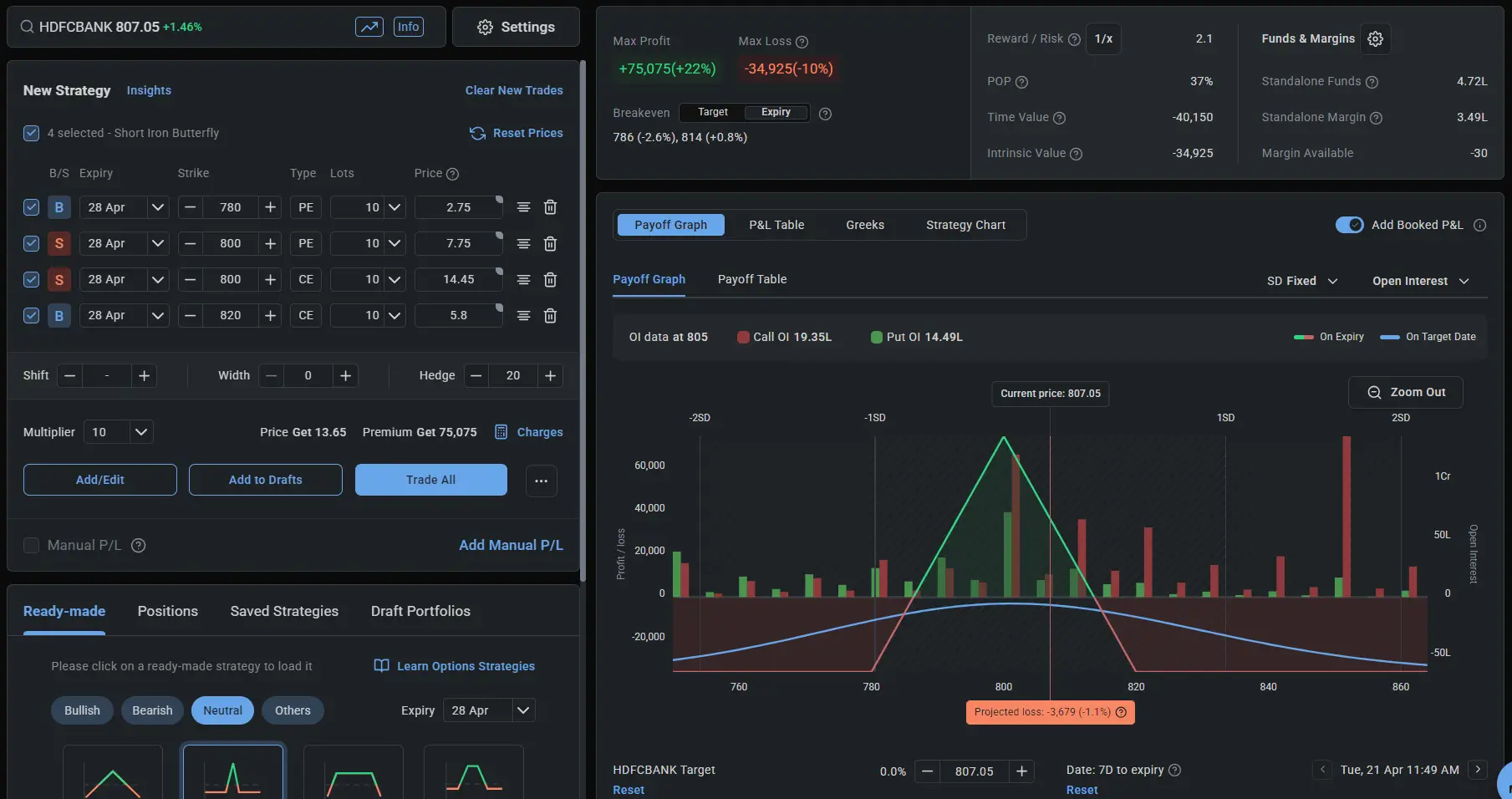
It is created by combining:
- A short At-The-Money (ATM) Call Option
- A short At-The-Money (ATM) Put Option
- A long Out-Of-The-Money (OTM) Call Option
- A long Out-Of-The-Money (OTM) Put Option
This structure creates a defined-risk setup that seeks to benefit when the stock remains near the central strike price as time passes.
Why Traders Use Iron Butterfly in HDFCBANK
HDFCBANK is one of the most actively traded banking stocks in the derivatives segment, making it a common candidate for options strategies during expiry.
When price action suggests controlled movement or consolidation, an Iron Butterfly may become relevant.
Key Reasons Traders Prefer This Setup
1. Works in Range-Bound Conditions
If HDFCBANK is expected to stay within a reasonable trading zone, the strategy can align with that market view.
2. Defined Risk on Both Sides
Unlike naked option selling, losses are capped through the protective long options.
3. Can Benefit from Time Decay
As expiry approaches, option premiums tend to decline. Structured premium-selling strategies may benefit from this decay if price remains stable.
4. No Need for a Large Directional Prediction
The setup does not require a major bullish or bearish move. It focuses more on controlled price behavior.
Where Many Traders Make Mistakes During Expiry
Expiry can create emotional decision-making, especially for traders without a framework.
Common Errors Include:
- Selling naked options without hedge protection
- Entering trades after a major move has already occurred
- Trading without adjustment rules
- Taking oversized positions due to overconfidence
- Ignoring volatility shifts and event risk
These mistakes often come from reacting emotionally rather than executing systematically.
If you want to avoid common expiry mistakes and trade with a rules-based framework, the Options Trading Foundations Program covers practical execution models.
How to Approach Iron Butterfly More Professionally
Using the strategy effectively involves more than selecting strikes.
Important Factors to Evaluate
Strike Selection Logic
Choosing the central strike should be based on:
- Current price location
- Option premiums
- Implied volatility
- Expected expiry range
Risk Management Framework
Before entering any trade, traders should define:
- Maximum acceptable loss
- Position size limits
- Exit conditions
- Adjustment triggers
Execution Discipline
Structured entries and exits often matter more than opinions.
Learn strike selection, adjustments, risk control, and execution frameworks inside our Options Trading Foundations Program.
Strategies Traders Should Understand Beyond Iron Butterfly
A well-rounded options trader should study multiple frameworks because different market conditions require different tools.
Examples include:
- Iron Condor – for wider range expectations
- Bull Put Spread – for moderately bullish views
- Bearish Collar – for portfolio hedging
- Debit Spreads – for directional participation with limited risk
Learning when to use each strategy can be more valuable than repeatedly using one setup in every market condition.
Why Structured Systems Matter in Options Trading
Random trades often produce inconsistent outcomes because they depend heavily on emotion, noise, and short-term reactions.
Structured systems, on the other hand, are built on:
- Repeatable logic
- Risk-defined setups
- Position sizing discipline
- Market condition filters
- Consistent review process
This process-first mindset can help traders improve decision quality over time.
Summary
The Iron Butterfly strategy in HDFCBANK expiry can be a useful structured approach when markets are expected to remain near a defined zone. It offers capped risk, potential time decay benefits, and reduced dependence on aggressive directional predictions.
However, success with any strategy depends less on the setup itself and more on strike selection, position sizing, execution discipline, and risk management.
Traders who focus on systems rather than opinions often develop more consistent long-term habits.
If you want to learn practical options strategies with a process-driven framework, consider exploring a structured learning path designed for serious market participants.
If you want to build consistency through structured options strategies, explore our Options Trading Foundations Program and start with a disciplined framework.
Risk Disclaimer
Options trading involves substantial risk and may not be suitable for all participants. Strategies such as Iron Butterfly carry defined risk, but losses are still possible. Traders should understand payoff structures, liquidity conditions, and margin requirements before execution.



Comments ()