
Nifty 50 Drawdowns 2026: Patterns, Recovery & Strategies | Replete Equities
Unpack Nifty 50 market drawdowns patterns, Feb-Mar pain, recovery timelines & stats for 2026. Replete Equities: Best investment solutions with hand-holding. Free strategy session—master wealth creation now!
Market drawdowns can feel like a punch to the stomach.
You see your portfolio value shrinking. You begin questioning your allocation. You wonder whether this correction is temporary — or something bigger.
That emotional discomfort is natural.
But here is what long-term data consistently shows: every major Nifty 50 drawdown in history has eventually recovered. In many cases, recoveries have been sharp and decisive, especially after February–March liquidity-driven corrections.
If you are searching for terms like “market drawdown patterns,” “Nifty 50 drawdowns recovery,” or “how to recover from market losses,” you are asking the right questions.
Because understanding drawdowns is not about fear. It is about structure.
Decades of Indian market data reveal a clear rhythm:
- Liquidity tightens.
- Valuations reset.
- Sentiment weakens.
- Markets stabilise.
- Recovery unfolds.
The real opportunity lies in recognising that drawdowns are part of the compounding process, not interruptions to it.
At Replete Equities, our focus is on helping investors navigate these cycles through structured, need-based wealth solutions. Rather than attempting to predict every market turn, we emphasise disciplined allocation, risk alignment, and portfolio resilience — so that inevitable corrections become manageable phases within a long-term growth journey.
Market pain is temporary.
Structured investing is enduring.
And when approached correctly, drawdowns can become the foundation of long-term wealth creation rather than a threat to it.
What Exactly Are Market Drawdowns — And Why Should You Care?
Imagine building a well-structured Nifty 50 portfolio during a strong bull market.
Your investments grow steadily. Confidence increases. Returns look impressive.
Then suddenly, the market corrects.
A 20–30% peak-to-trough decline wipes out months — sometimes years — of visible gains.
That is a market drawdown.
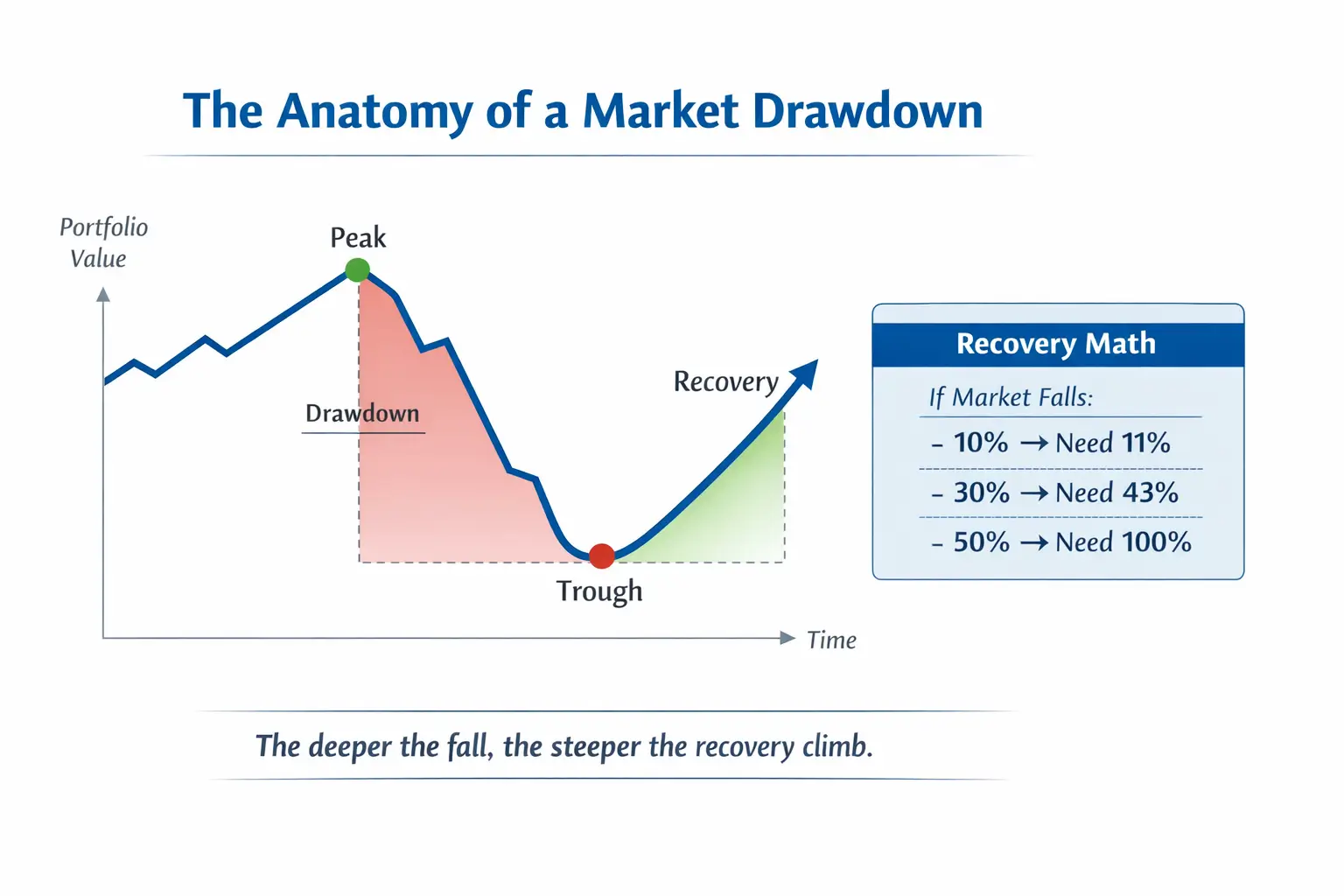
In simple terms, a drawdown is the percentage decline from your portfolio’s highest value to its lowest point before recovery begins.
But it is not just a mathematical event.
It is a psychological test.
It challenges patience.
It tests conviction.
It exposes risk tolerance.
Many investors look at long-term Nifty 50 returns, often 12–15% CAGR over extended periods — and assume volatility is manageable.
However, long-term returns hide the journey required to achieve them.
Consider the mathematics:
- A 10% fall requires an 11% gain to recover.
- A 30% fall requires a 43% gain.
- A 50% fall requires a 100% rebound.
This phenomenon is known as recovery asymmetry.
The deeper the drawdown, the harder the climb back.
This is why unmanaged drawdowns can severely damage long-term wealth creation. Panic selling during corrections converts temporary market declines into permanent capital loss.
Historical examples reinforce this principle.
During the 2008 Global Financial Crisis, the Nifty fell nearly 65% and took approximately 71 months to fully recover.
In contrast, the COVID-19 crash of 2020 saw a sharp 40% fall, followed by a recovery in roughly 10 months.
The severity of the fall did not strictly determine the speed of recovery.
Investor behaviour during the drawdown often determined long-term outcomes.
Those who exited during panic missed recovery phases.
Those who stayed disciplined participated in compounding.
This is why drawdown management is central to structured wealth building.
At Replete Equities, portfolio construction focuses on aligning risk exposure with client tolerance levels, ensuring allocation decisions are designed to withstand volatility rather than react to it.
Because successful investing is not about avoiding corrections.
It is about being prepared for them.
Decoding Seasonal Market Drawdown Patterns in Nifty 50
If you study Indian equity markets carefully, one recurring pattern stands out.
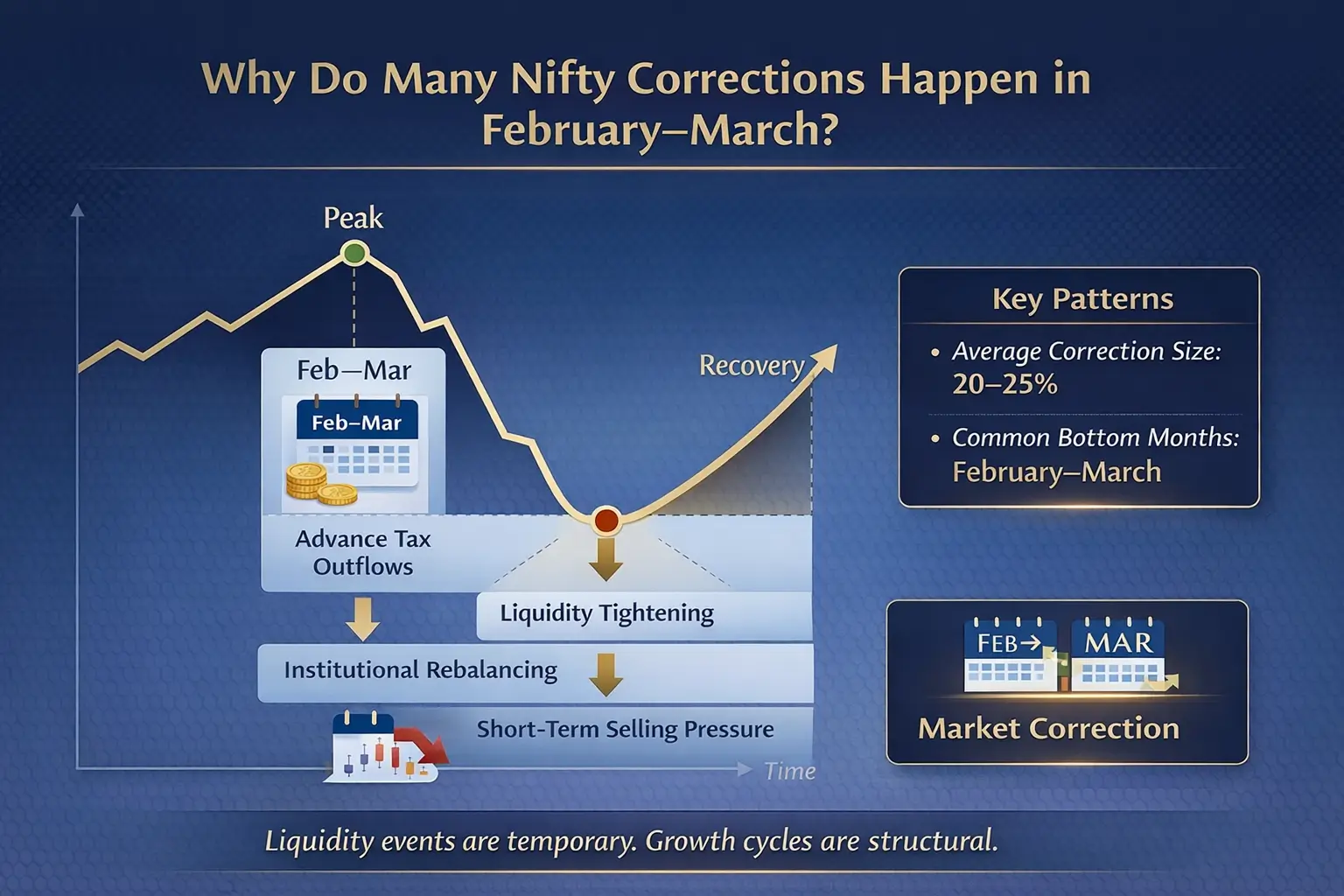
A significant number of market bottoms tend to form around February and March.
This is not coincidence. It is structural.
Several forces converge during this period:
- Advance tax outflows reduce system liquidity
- Financial year-end adjustments increase selling pressure
- Institutional portfolio rebalancing intensifies
- Risk appetite temporarily declines
When liquidity tightens, prices often correct — sometimes sharply.
Small-cap indices typically amplify this effect. They fall more aggressively during stress phases due to lower liquidity and higher volatility. However, they also tend to rebound strongly once liquidity conditions normalize.
Looking at historical Nifty 50 drawdowns since 2009, the average meaningful correction has been around 20–25%, with a noticeable clustering of bottoms in the February–March window.
Recovery phases have often been decisive, with many cycles delivering strong rebounds within months.
Here is a structured snapshot of past cycles:
| Year | Drawdown | Bottom Month | Recovery Time | Bounce Strength |
|---|---|---|---|---|
| 2009 | -24% | March | 11 months | Strong surge |
| 2011 | -21% | February | 2 months | Swift rebound |
| 2013 | -21% | March | 12 months | Steady climb |
| 2016 | -24% | February | 14 months | Robust |
| 2018 | -20% | March | 1 month | Lightning fast |
| 2020 | -47% | March | 12 months | Explosive |
| 2022 | -22% | February | 1 month | Quick snapback |
| 2023 | -11% | March | 11 months | Solid |
| 2025 | -23% | March | 5 months | Vigorous |
| 2026 | -9% | Ongoing | TBD | Primed? |
When you look at this data objectively, a few consistent patterns emerge:
- Many meaningful corrections cluster in February–March.
- The average drawdown is often in the 20–25% range.
- Recovery strength varies, but rebounds are common.
- Severe crashes have historically been followed by strong upside phases.
These are not random failures of the market.
They are recurring liquidity-driven adjustments within a larger growth cycle.
Small-cap segments, in particular, tend to overshoot on the upside after sharp drawdowns. However, they also carry higher volatility, which reinforces the importance of allocation discipline.
The key takeaway is simple:
- You do not need to predict the exact bottom.
- You need to avoid selling at the bottom.
Understanding seasonal drawdown patterns reduces emotional decision-making and allows for structured, rational portfolio management.
- Markets move in cycles.
- Liquidity tightens.
- Valuations reset.
- Sentiment improves.
- Recovery unfolds.
Investors who understand this rhythm are better positioned to navigate volatility with confidence.
Major Nifty 50 Drawdowns: Lessons from Pain to Recovery
To truly understand market drawdowns, we must zoom out and study major historical events.
Short-term corrections are one thing. Structural crashes are another.
Over the past few decades, the Nifty 50 has faced multiple deep drawdowns — each painful in the moment, but educational in hindsight.
Let’s revisit some of the most significant ones.
The Dot-Com crash (2000–02) pushed the index down by approximately 53%. It took about 46 months for the market to fully recover.
The Global Financial Crisis in 2008 was even more severe. The Nifty fell nearly 65% and required around 71 months to regain previous highs.
The 2015–16 correction was milder at about 25%, with recovery in roughly two years.
Then came COVID-19 in 2020 — a sharp 40% drawdown, followed by a remarkably fast 10-month recovery phase.
Across more than 35 years of Nifty 50 history, one powerful observation stands out:
No 5-year rolling period after a major crash has remained negative.
That is not optimism.
That is long-term structural market behaviour.
Why does this matter?
Because investors often assume that a severe fall means a long period of stagnation. History shows that while recovery timelines vary, recovery itself has been consistent.
Let’s look at the data clearly.
| Crisis/Event | Max Drawdown | Recovery Time | Post-Recovery Gain (1 Year) |
|---|---|---|---|
| Dot-Com (2000-02) | -53% | 46 months | +50%+ |
| GFC (2008) | -65% | 71 months | Explosive bull run |
| COVID-19 (2020) | -40% | 10 months | Tripled in 2 years |
| Gold (Avg Major) | -40%+ | 7 years | Modest |
| Silver (Avg) | -60%+ | 9 years | Volatile, slow |
Now observe the pattern carefully.
Equities have historically recovered faster than precious metals after major crashes.
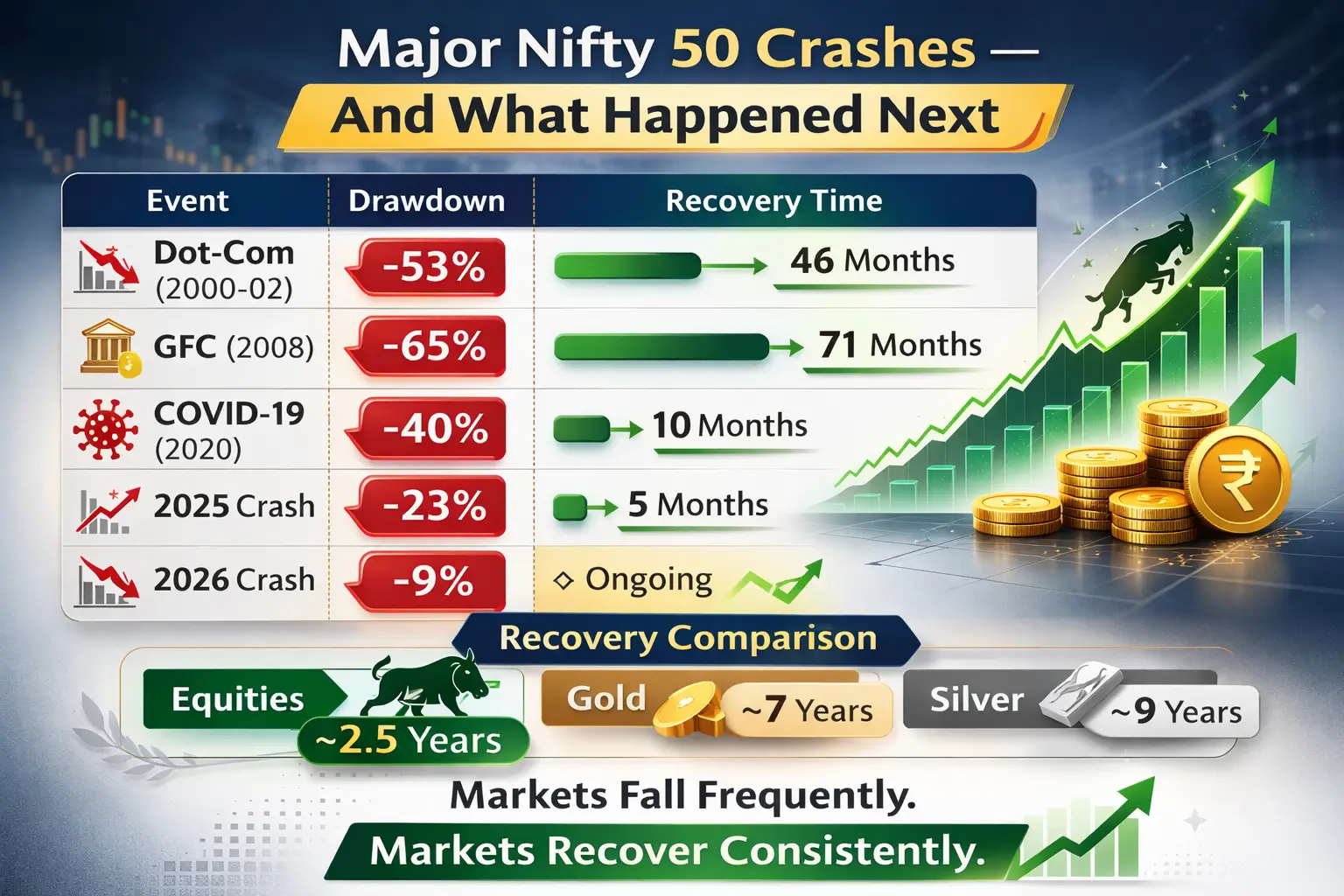
Gold often provides stability during panic phases.
Silver tends to be highly volatile and takes longer to consolidate.
But broad equity markets, especially large-cap indices like Nifty 50, have demonstrated structural resilience over time.
Another important takeaway is recovery acceleration.
The COVID crash recovered much faster than the Global Financial Crisis. The severity of the fall did not strictly determine the speed of the rebound.
Which brings us to the most important principle.
Controlling maximum drawdown is the lifeline of any portfolio.
If your portfolio experiences an uncontrolled 50–60% fall, recovery becomes mathematically and emotionally difficult.
If drawdowns are managed within a reasonable range aligned to your risk tolerance, staying invested becomes easier.
And staying invested is what ultimately allows compounding to work.
Long-term wealth creation is not about avoiding every crash.
It is about building portfolios that survive crashes and participate fully in recovery cycles.
That is where disciplined allocation, diversification, and structured review become essential.
Why SIPs and Discipline Trump Timing in Market Pain Recovery
Ever wonder why SIP investors laugh at drawdowns? Because systematic investing dollar-cost averages you into the dip, turning market pain into your gain. During average -24% Nifty drawdowns, SIPs scoop units cheap, positioning for that 64% bounce.
Panic selling? That's the trap.
I've counseled clients mid-2020 crash who exited at -40%, missing the V-shaped recovery.
Today, with "market drawdowns patterns pain recovery" dominating searches, remember:
Drawdowns are the price of admission to compounding. They're structural, liquidity-driven, seasonal, not existential threats.
Key takeaways I've drilled into hundreds of traders:
- Feb-Mar corrections are buyable if you're hedged.
- Small caps lead Nifty 50 drawdowns recovery.
- Behaviour beats prediction—stay invested.
- Maximum drawdown metrics define survivability.
In our Replete Equities mentorship, you get one-on-one hand-holding: Custom strategies, live trade walkthroughs, and psychology coaching. We don't abandon you in drawdowns; we navigate them together.
Absolutely. Here is the rewritten section — positioned clearly as a Financial Product Distributor (FPD), focused on curated wealth solutions, client-centric structuring, and long-term partnership. No mention of financial advisor, mentorship, or premium baskets.
Replete Equities: Curated Wealth Solutions Built Around You
You don’t need generic investment tips.
You need structured solutions aligned with your financial goals, risk tolerance, and time horizon.
At Replete Equities, we operate as a Financial Product Distributor (FPD) focused on curating wealth-creating investment solutions based on individual client needs. Every investor is different. Their allocation should be different too.
Founded by Sachin Sival, with over 13 years of experience navigating Indian markets, our foundation is built on disciplined risk understanding, drawdown awareness, and long-term wealth structuring.
We are Jaipur-based and serve clients across India who want clarity, structure, and informed investment decisions.
What Makes Us Different?
We don’t manufacture products.
We curate them.
Our role is to evaluate available financial instruments and structure them intelligently for you. This includes:
- Equity mutual funds aligned to growth objectives
- SIP-based long-term compounding strategies
- Structured products for defined outcomes
- Alternative diversification opportunities
- Asset allocation frameworks built around risk tolerance
Every recommendation is goal-oriented and need-based.
Not trend-based.
How We Support You During Market Drawdowns
Market corrections test confidence.
During volatile phases, many investors feel uncertain. This is where structured guidance matters.
At Replete Equities, we focus on:
• Reviewing portfolio allocation during corrections
• Rebalancing exposure where required
• Ensuring risk alignment remains intact
• Communicating clearly during uncertain phases
• Helping clients avoid emotional decision-making
When markets corrected sharply in 2025, disciplined allocation and structured diversification helped clients navigate volatility without unnecessary panic.
We do not promise zero volatility.
We focus on resilient positioning.
Because wealth creation is not about avoiding drawdowns — it is about surviving them intelligently.
In Volatile Markets, Structure Matters More Than Prediction
When markets correct, generic advice often sounds like “just hold” or “buy the dip.”
But successful wealth creation requires more than slogans.
It requires:
Clarity of allocation.
Defined risk boundaries.
Diversification across asset classes.
Ongoing review and adjustment.
Your financial growth should not depend on luck.
It should be built on structure.
Turning Knowledge Into Action
You’ve understood how market drawdowns work.
Now the question is — is your portfolio structured to handle them?
If you want:
• A structured review of your current investments
• A better-aligned asset allocation
• Curated wealth solutions suited to your goals
• A disciplined long-term investment framework
We invite you to schedule a personalised portfolio discussion.
We will:
• Assess your current exposure
• Evaluate drawdown sensitivity
• Align investments with long-term objectives
• Build a resilient wealth roadmap
Call us at +91-7229945555
Or email [email protected]
Markets will continue to move in cycles.
With the right structure, every cycle becomes an opportunity for steady wealth creation.
At Replete Equities, we focus on building sustainable financial growth — thoughtfully, carefully, and consistently.

Comments ()