
Silver Price Crash 2026: Why it Fell ₹88,000 and Where to Buy Now
Silver crashed ₹88,000 in 48 hours in 2026. Understand the real reasons behind the fall and identify safe buying zones using expert technical analysis.

At Replete Equities, we often say this with conviction—and with experience to back it:
Markets don’t punish ignorance immediately; they punish overconfidence brutally.
The Silver “Flash Crash” of January 2026 is a textbook example of why discipline, data, and risk management are non-negotiable in commodity markets. What unfolded over just 48 hours wiped out billions in notional value, shook retail traders, and once again exposed the dangers of chasing price without understanding positioning, macro triggers, and technical exhaustion.
This was not a black swan.
This was a predictable mean-reversion event—and we had been warning about it well in advance.
When a 70% Rally Turns Parabolic, Caution Is Not Optional
Silver had been on a dream run. From late 2025 into January 2026, the metal surged nearly 70%, racing from around ₹3,00,000 to above ₹4,20,000 per kg on the MCX—in just nine trading sessions.
Parabolic moves feel exciting. They create headlines, WhatsApp forwards, and the illusion that “this time is different.” But seasoned market participants know one truth:
Vertical rallies rarely sustain without deep, painful corrections.
For weeks, we consistently highlighted that silver had entered an extreme overbought zone—both technically and sentiment-wise. Momentum indicators were stretched, open interest was crowded on the long side, and retail participation had reached euphoric levels.
Followers who acted rationally—by booking partial profits, tightening trailing stop-losses, or reducing leverage—managed to protect capital when the tide turned.
Those who didn’t learned an expensive lesson.
What Triggered the ₹88,000 Collapse in Silver Prices?
On January 29, 2026, Silver printed a lifetime high of ₹4,20,048/kg.
By January 31, prices had collapsed to nearly ₹3,32,000.
An almost ₹88,000 fall per kg in two days is not random volatility. It was a perfect storm, driven by three powerful forces acting together.
1. The Hawkish Macro Shock
The first trigger came from global macro sentiment. The nomination of Donald Trump’s preferred candidate, Kevin Warsh, as the next US Federal Reserve Chair changed the interest-rate narrative overnight.
Warsh is widely seen as an inflation hawk—someone far less tolerant of loose monetary policy. Markets immediately began pricing in the possibility of higher-for-longer interest rates.
The result?
- The US Dollar strengthened sharply
- Non-yielding assets like silver lost relative appeal
- Algorithmic funds flipped from risk-on to risk-off
Macro matters—especially in commodities.
2. The Reuters Headline That Sparked Panic
The second trigger was psychological—and dangerously misunderstood.
A Reuters report related to US strategic metal support was misinterpreted by automated trading systems. Within minutes, algorithmic sell programs were activated across global commodity desks.
Once such programs kick in, price discovery becomes mechanical, not emotional. Stop-losses get hit. Liquidity dries up. Slippage increases. Panic feeds on itself.
Retail traders rarely realize this in real time—but by the time they do, the damage is already done.
3. Forced Liquidations and the Leverage Trap
The final blow came from excessive leverage.
As silver began to fall, traders holding aggressive long positions were hit with margin calls. Brokers squared off positions automatically. Each forced sell pushed prices lower, triggering more margin calls in a vicious domino effect.
This is how sharp corrections become flash crashes.
Leverage doesn’t give you power.
It removes your ability to wait.
Technical Reality Check: Where Can Silver Stabilize Now?
At Replete Equities, we don’t try to catch falling knives. We don’t hunt for the “lowest” price.
We look for the safest zones where risk is defined and probability improves.
Here’s what the charts are telling us now.
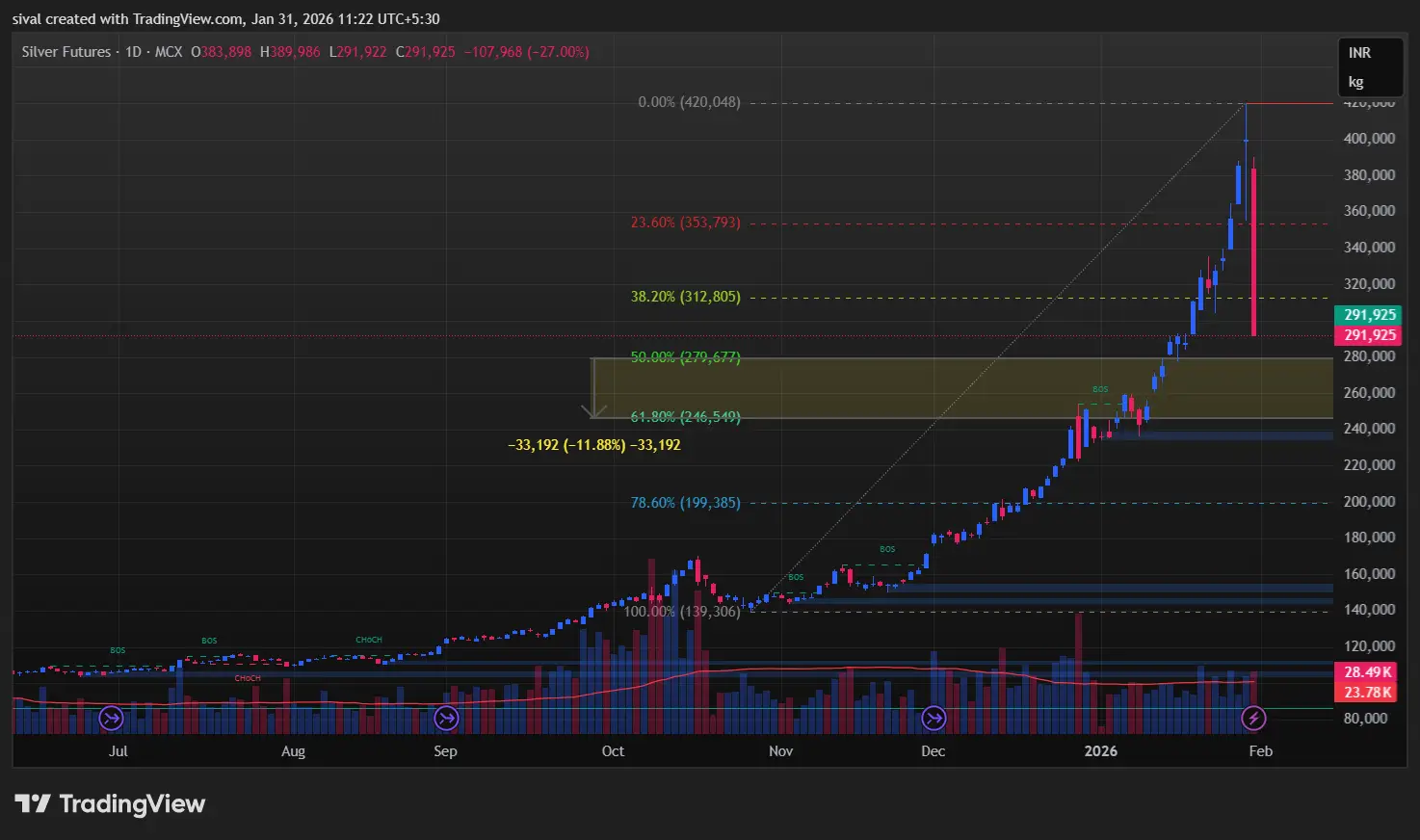
Immediate Support: The 50-Day EMA Zone
Silver is currently hovering around ₹3,32,000 - ₹3,35,000, which coincides with the 50-day Exponential Moving Average (EMA).
- This zone may act as a temporary demand area
- A short-term relief bounce toward ₹3,60,000 is possible
- But make no mistake—this would be a technical bounce, not a trend reversal
Traders should stay nimble here.
The Psychological Line in the Sand: ₹3,00,000
The ₹3 lakh level is critical.
A sustained break below this zone would:
- Signal a structural shift in trend
- Invite longer-term bearish positioning
- Change the risk profile for positional investors
This is a must-hold level for silver bulls.
The True Value Zone for Long-Term Investors
For investors with patience and capital discipline, the most attractive accumulation zone lies much lower—around ₹2,42,000 to ₹2,80,000.
Why this zone matters:
- It marks the original breakout base from late 2025
- Strong historical demand is visible on volume profiles
- Risk–reward becomes asymmetrically favourable here
Good investments are not made in excitement—they are made in boredom and fear.
The Replete Equities View: Fundamentals Are Strong, But Price Still Rules
There is no denying silver’s long-term industrial relevance.
- Solar energy adoption
- Electric vehicles
- AI chips and advanced electronics
All of these support silver’s structural demand story.
But markets don’t move on stories alone.
A great asset bought at the wrong price becomes a bad investment.
The January 2026 crash reinforces a core principle we teach every trader and investor we work with:
Volatility Is Not the Enemy. Lack of a Plan Is.
If you are holding silver today:
- Avoid blind averaging down
- Wait for clear technical confirmation
- Respect trend structure and risk limits
Capital preservation always comes before capital growth.
Not Sure What to Do Next?
Reading market views is only the first step. What matters is choosing the right approach based on where you are as a trader or investor.
At Replete Equities, we follow a clear, structured path — from learning, to execution, to mastery.
Start Here – Find Your Right PathNo selling. No pressure. Just clarity.
Final Thoughts: Discipline Is the Real Edge
The Silver Flash Crash of 2026 will be remembered not just for its speed—but for what it exposed.
Markets reward:
- Preparation over prediction
- Process over opinions
- Discipline over hope
At Replete Equities, our mission has always been to help traders and investors navigate volatility intelligently, not emotionally.
Stay disciplined. Stay informed. And above all—trade with a plan.
Confused whether to Buy, Hold, or Exit Silver at current levels?
Book a 1:1 Strategy Call with Replete Equities and get a risk-managed action plan tailored to your capital and timeframe.
Frequently Asked Questions (FAQs)
Why did silver price crash in 2026?
Silver prices crashed sharply in January 2026 due to a combination of macroeconomic and market-driven factors.
The primary triggers included a hawkish shift in US monetary policy expectations, a sudden strengthening of the US Dollar, panic-driven algorithmic selling after a misinterpreted global news report, and forced liquidations caused by excessive leverage in long positions.
When all these factors aligned, silver witnessed a rapid ₹88,000 fall within just 48 hours.
How much did silver fall during the 2026 crash?
Silver fell by nearly ₹88,000 per kg on the MCX, dropping from its all-time high near ₹4,20,000 to around ₹3,32,000 in less than two trading sessions.
Such a sharp fall classifies it as a flash crash, driven more by positioning and liquidity stress than by any deterioration in long-term fundamentals.
Is the silver price crash a buying opportunity?
A price crash alone does not automatically create a buying opportunity. While silver’s long-term industrial demand remains strong, price behaviour, trend structure, and confirmation matter.
Prudent investors wait for:
- Stability near key support levels
- Clear technical reversal signals
- Reduction in volatility and leveraged positions
What are the best levels to buy silver after the crash?
From a risk-managed perspective, silver shows potential accumulation interest in stages:
- ₹3,32,000–₹3,35,000: Short-term technical support (high-volatility zone)
- ₹3,00,000: Critical psychological support
- ₹2,42,000–₹2,80,000: Strong long-term value zone based on historical structure
Long-term investors should focus on staggered buying rather than lump-sum entries.
Should investors average down in silver after the fall?
Averaging down in a falling market without confirmation can be risky. While averaging works in range-bound markets, it can significantly increase losses during trending corrections.
Investors should wait for:
- Trend stabilisation
- Volume confirmation
- Structural support holding
Capital preservation should always take priority over recovery trades.
Is silver still a good long-term investment after this crash?
Yes, silver continues to have strong long-term relevance due to its role in solar energy, electric vehicles, electronics, and advanced manufacturing.
However, long-term success depends not just on the asset, but also on entry price, position sizing, and holding discipline. Even fundamentally strong assets can underperform if bought at extreme valuations.
What lesson should investors learn from the silver flash crash?
The biggest lesson from the 2026 silver crash is simple: volatility is manageable, but lack of a plan is not.
Traders and investors who followed risk management — such as profit booking, trailing stop-losses, and low leverage — were able to protect capital.
How can retail investors protect themselves from such crashes?
Retail investors can reduce risk by:
- Avoiding excessive leverage
- Using predefined stop-loss levels
- Not chasing parabolic price moves
- Diversifying across asset classes
- Following a written trading or investment plan
Discipline and patience remain the most reliable tools in volatile markets.
📌 Disclaimer
The information provided in this article is for educational and informational purposes only and should not be construed as investment advice, trading advice, or a recommendation to buy or sell any financial or commodity instrument. Silver prices and commodity markets are subject to high volatility and can be influenced by global macroeconomic factors, policy decisions, liquidity conditions, and market sentiment.
Past price movements and technical levels discussed are not guarantees of future performance. Readers are advised to conduct their own independent research and consult with a SEBI-registered investment advisor or financial professional before making any investment or trading decisions.
Replete Equities, its affiliates, and its representatives shall not be held responsible for any financial losses, direct or indirect, arising from actions taken based on the information presented in this article.
Investments in commodities involve market risk. Please trade and invest responsibly.
Comments ()