
STT, Tax Rules, Algo Compliance: What April 1 Means for Indian Traders
April 1 introduces higher STT, new tax rules, and stricter algo compliance. Learn how Indian traders can adapt with disciplined, cost-aware strategies.
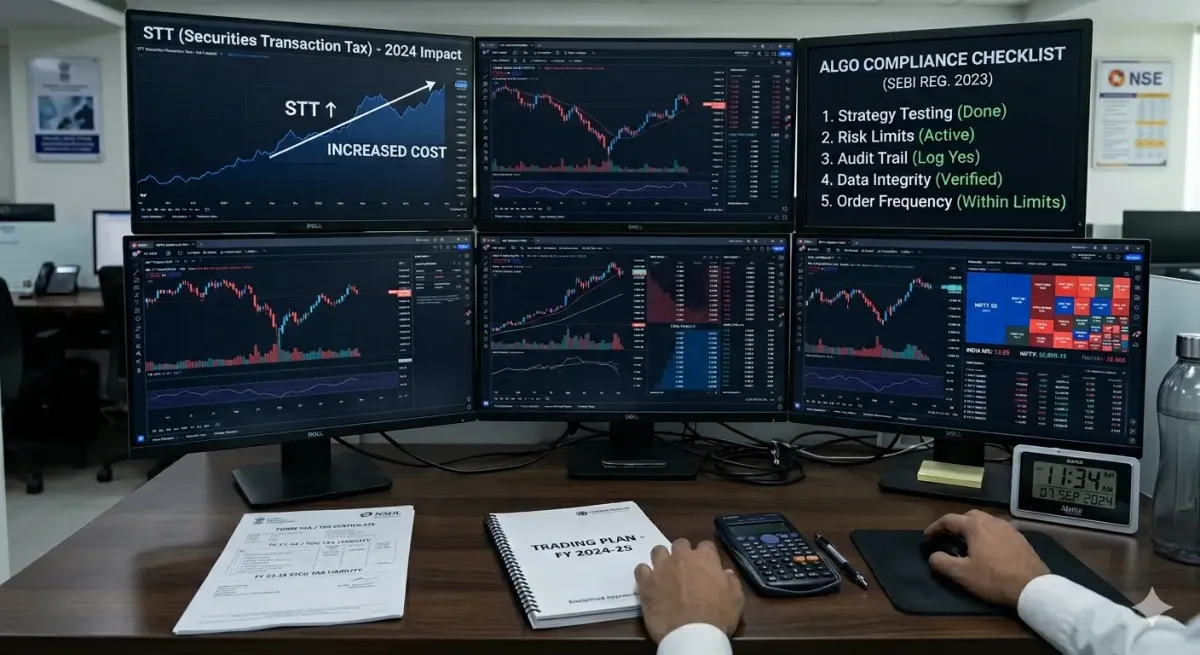
If you’re an active options trader in India, April 1 is not just another date on the calendar. It’s a quiet but powerful reset for the way you trade, plan your risk, and handle your tax obligations.
From April 1, 2026, three big changes come into play at the same time: higher STT on futures and options, new tax rules that tighten reporting and compliance, and stricter algo‑trading compliance enforced by SEBI.
For years, many traders have relied on low‑cost, high‑frequency strategies, weak risk controls, and informal record‑keeping. Now the environment is shifting, and those who adapt fastest will be the ones who stay profitable.
In this article, I want to talk to you as a fellow trader, not just as a commentator on the news. I’ll walk you through what these changes really mean for your P&L, your risk management, and your day‑to‑day trading decisions.
I’ll show you how the new rules will change your trading math, why some strategies will suddenly feel more painful, and how you can restructure your approach so that you are not just surviving the new regime, but actually thriving in it.
By the end, you’ll also see how programs like the Option Trading Foundations Program can help you turn this regulatory shift into a disciplined, long‑term edge.
Why April 1 matters for traders like you
You and I both know that April 1 has always been a “reset” day in India. It’s the start of a new financial year, a new tax regime, and new rules from SEBI and the government. But this year, the story feels different.
This time, the changes are not abstract; they are hitting the same group of people every day—active traders and options participants. Higher STT, tighter tax scrutiny, and stricter algo‑compliance rules are all coming together on the same date, and they all affect you directly.
If you sit in front of your trading screen, you’re already dealing with volatility, slippage, and emotions. The new rules add another layer of friction and accountability.
You don’t just pay more per trade; you also have to think harder about your records, your tax treatment, and the way your automated systems are designed.
If you keep trading the same way, your breakeven will move higher, and your edge will shrink. But if you use this change as a reason to clean up your process, you can turn it into an advantage.
The market is quietly selecting for traders who treat their activity like a business, not a hobby. That’s the mindset you need to adopt from April 1. You are not just “playing the market”; you are running a trading business, and the new rules are encouraging you to run it like one.
STT hike on F&O: How it changes your trading math
Let’s start with the most direct change: STT. Before April 1, STT on futures and options was relatively low, and it didn’t have a huge impact on low‑premium trades.
Futures STT used to be around 0.02%, and options STT on the premium side was also comparatively light. This allowed many traders to chase tiny premiums, expiry‑day scalps, and short‑term bets without worrying too much about the tax impact on each trade.
From April 1, 2026, that changes. The STT on futures jumps to 0.05%, and options STT on the premium or exercise side rises to 0.15%, depending on the contract type.
This is a big jump in percentage terms, especially for low‑premium options. Imagine a scenario where you buy an OTM option for ₹10 per lot. At the old STT rate, the tax impact was small relative to the premium.
At 0.15% STT, that same ₹10 option now has a higher percentage of its value eaten by the tax. If you’re scalping dozens or even hundreds of such trades per month, that friction adds up quickly.
From my own experience talking to traders, I’ve seen many of you living on very thin margins, especially in high‑frequency, low‑premium strategies. The STT hike doesn’t invalidate your edge overnight, but it does make it harder to profit from marginal trades.
You now need a clearer edge, better timing, and more careful risk management, because the overhead cost of trading has gone up. If you ignore this, you might look profitable on paper, but once you factor in STT, commissions, and slippage, your net returns can start shrinking.
Which trading styles feel the pain the most?
The STT hike doesn’t hit every trader equally. The ones who feel the impact the most are usually those who rely on high‑volume, low‑premium trades and expiry‑day speculation.
If you’re the kind of trader who opens 30–40 positions a day purely chasing small moves in OTM options, your cost structure is now less efficient. The STT alone can destroy the edge of trades that were already marginal.
Expiry‑day scalping on cheap OTM options becomes a lot more expensive. Every time you enter and exit a position, you’re paying a higher STT toll.
If you’re selling premium in very tight spreads, the same problem appears from the other side: your breakeven is pushed higher, and the probability of ending in a small profit or loss zone increases. That’s why I often tell traders to step back and ask: “Is this trade worth the new friction?”
On the other hand, if you’re already using defined‑risk structures like spreads, strangles, or iron butterflies, you’re in a better position. These strategies are more robust to higher transaction costs, because your risk and reward are clearly bounded.
The tax hit per contract is still there, but the overall structure gives you more control over your downside. That’s why I think the STT change is actually a catalyst to move away from naked, one‑legged bets and toward more structured, risk‑defined trading.
New tax rules and how they change your mindset
Beyond STT, April 1 also brings a new tax regime. The government has rolled out new income‑tax rules and updated compliance norms, which affect how your trading income is treated and reported.
For many traders, this is uncomfortable, because it forces them to think about their activity in a more formal way. But from my perspective, this is actually healthy.
If you’re one of those traders who still think of yourself as a “casual investor” even though you take 20-30 positions a week, this new environment will push you to confront that label.
The new rules tighten TDS/TCS, improve tracking of high‑value transactions, and make it easier for the tax department to see repetitive trading patterns that look like a business rather than an occasional investment.
This means you either need to own your trader identity or change your scale of activity.
You don’t need to be a CA to handle this,
But you do need to change your habits. Start by keeping a simple log of your trade date, scrip, strategy, premium, entry, exit, and reason.
If you’re using APIs or algo systems, this becomes even more important because your automation is now part of a formal, auditable trail.
The new tax framework is not your enemy; it’s a reason to clean up your process and turn your trading into a structured activity instead of a collection of random bets.
Algo compliance and how it affects your automation
The third big change from April 1 is algo compliance. SEBI has introduced a clearer framework for algorithmic trading, which means brokers now have to ensure that retail algo setups follow stricter risk controls and testing protocols. This is a big shift from the earlier era, where traders could more or less plug in any script and let it run.
If you’re using automated strategies, whether they are your own coded systems or broker‑provided algo tools, this is going to affect you directly.
You’ll see more pre‑approval requirements, mandatory risk checks, and position‑sizing controls embedded in your algo structure.
In practice, this means you can’t just deploy a bot that chases every signal without any regard for market conditions. The system now has to respect your predefined risk, and brokers have to monitor that it’s behaving as designed.
From my point of view, this is a good thing.
The wild‑west phase of algo trading is ending, and that’s beneficial for serious traders. If you use automation, the new rules force you to think through your strategy more carefully.
You need to test your algo in different market conditions, understand its worst‑case drawdown, and make sure it can handle volatility without blowing up your account. This is exactly the kind of discipline that separates profitable traders from those who survive only in easy markets.
How you should change your trading plan after April 1
Now that we’ve seen the three big changes—STT hike, new tax rules, and tighter algo-compliance, let’s translate them into a concrete trading plan.
I want you to read this part as a personal checklist for how you should adapt your process from April 1 onward.
👉First, I want you to reduce your over‑trading habit. If you’re like most traders I’ve seen, you often open trades because you feel “bored” or “missed the move” rather than because you have a clear edge.
The higher friction from STT makes this kind of behavior very expensive. Instead of trading 30–40 times a week, you can aim for 5–10 high‑quality setups where your edge is obvious. This reduces your transaction cost, improves your focus, and lowers emotional stress.
👉Second, I want you to shift toward defined‑risk strategies. If you’re still doing a lot of naked option buying or selling, now is the time to reconsider. Spreads, strangles, and iron butterflies give you more control over your risk while still allowing you to express your view on volatility and direction.
You’ll pay more STT per trade, but the trade‑off is that your downside is limited, and your planning becomes clearer. This is especially important for premium‑selling traders who rely on time decay; you need to make sure your edge is wide enough to survive the new friction.
👉Third, I want you to treat every trade as a business decision, not just a market bet. That means calculating your breakeven more carefully, including STT, commissions, and slippage.
If your expected profit is less than 2–3 times the total cost of the trade, then you should seriously question whether it’s worth taking. This forces you to avoid low‑edge trades and focus on setups where your edge is clear and repeatable.
👉Fourth, I want you to get ahead of your tax planning instead of leaving it to the last moment. This is not glamorous work, but it is essential.
Start by keeping a daily or weekly P&L log, and track whether your activity is treated as speculative income or business income under the new rules.
If you’re unsure, I strongly recommend speaking with a tax professional early in the year, not after March 31. The new tax framework is meant to make compliance easier, but only if you’re proactive about it.
How the Option Trading Foundations Program can help you adapt
If all of this feels like a lot to digest at once, you’re not alone. Many traders are going through the same mental shift: from a “quick‑trade” mindset to a more structured, professional approach.
That’s exactly why we created the Option Trading Foundations Program at Replete Equities. It’s designed for traders like you who want to upgrade their skills, not just chase the next hot setup.
In this program, we walk you through the core concepts of option pricing, volatility, and risk management, and then we show you how to apply them in a live trading environment.
- You’ll learn how to build defined‑risk strategies,
- how to calculate your breakeven accurately,
- and how to size your trades in a way that respects your capital and your mental bandwidth.
The program also includes practical guidance on journaling, backtesting, and using automation in a way that aligns with the new algo‑compliance and tax environment, so you can adapt without feeling overwhelmed.
You can explore the Option Trading Foundations Program here:
👉 Option Trading Foundations Program
It’s not a magic formula, but it is a structured framework that can help you make better decisions, trade with more discipline, and stay ahead of the regulatory changes that are coming your way.
Final thoughts: April 1 as a reset, not a roadblock
April 1 is not the end of profitable trading in India. It’s a reset moment where the market weeds out the casual over‑traders and rewards those who treat their activity like a business.
The STT hike, new tax rules, and tighter algo‑compliance are all designed to increase friction and accountability, but they also create more room for disciplined, well‑structured traders like you.
If you’re reading this, you’re already ahead of the curve. The question is whether you’ll treat April 1 as a constraint or as a challenge to improve your edge.
I hope this article gives you a clear roadmap for how to adapt your trading plan and how to use the new rules as a reason to become more professional, not less.
If you want to dig deeper into specific strategies that work best under the new regime, I strongly encourage you to check out the Option Trading Foundations Program on Replete Equities and let us help you build a more sustainable, profitable trading future.
Not Sure What to Do Next?
Reading market views is only the first step. What matters is choosing the right approach based on where you are as a trader or investor.
At Replete Equities, we follow a clear, structured path — from learning, to execution, to mastery.
Start Here – Find Your Right PathNo selling. No pressure. Just clarity.

Comments ()