
Tomorrow Market Prediction: Nifty, Bank Nifty Support & Resistance for March 04, 2026
Nifty and BankNifty Prediction for Mar 04, 2026. Discover key levels, market sentiment, and why the private banking sector is the one to watch in today's session. Expert analysis by Replete Equities.

As we step into tomorrow’s session, the Indian stock market comes after a highly volatile day where indices opened with a deep gap-down but managed to recover part of the losses by the close.
Geopolitical tensions and a spike in crude oil kept sentiment weak, while options data and sector performance hint at a cautious, range‑bound bias for the next trading day rather than an all‑out trend move.
Indian Stock Market Prediction for Tomorrow: How the Market Closed Today
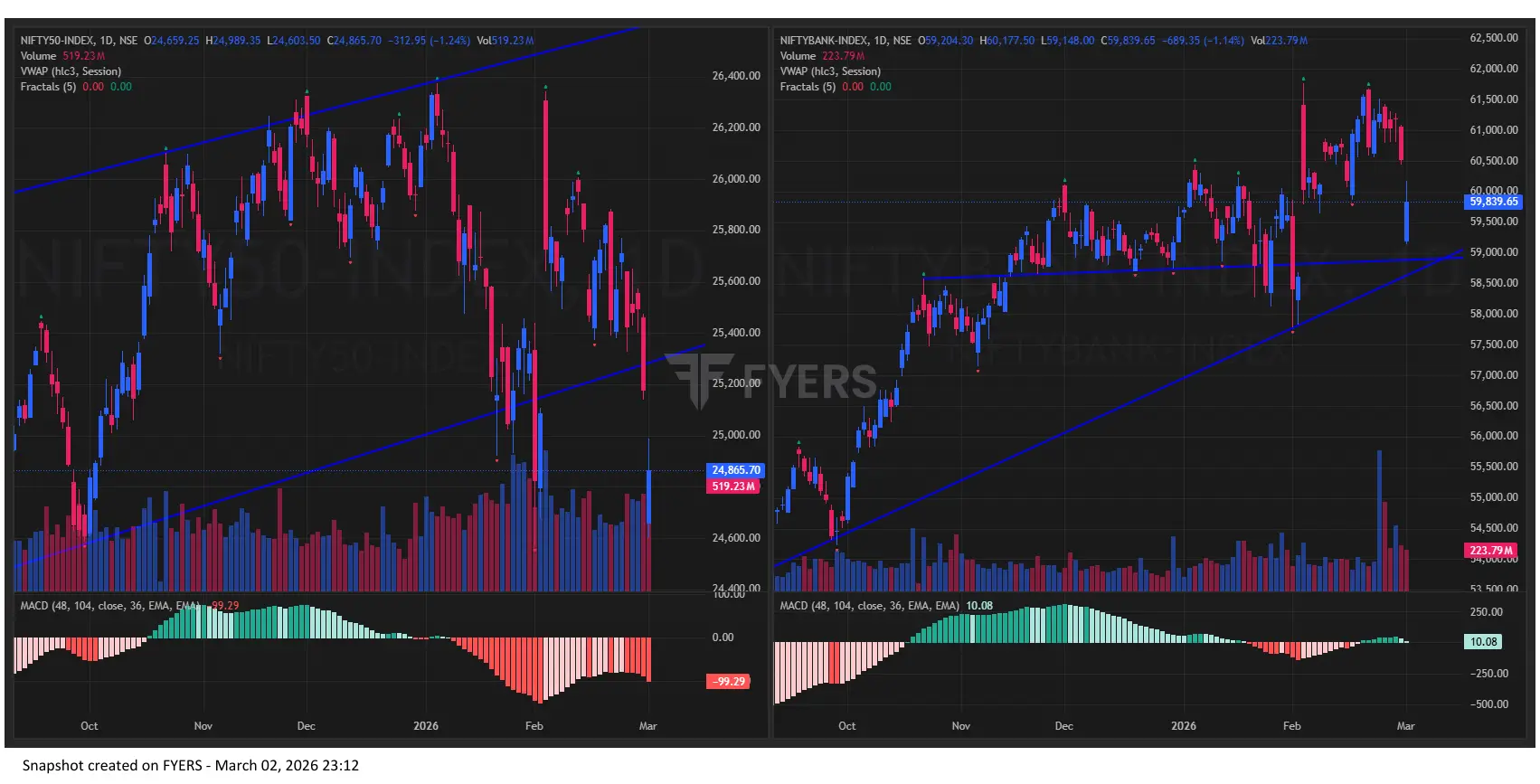
Today, Nifty 50 opened sharply lower near 24,659, attempted a recovery towards 24,989, and finally settled around 24,865, down roughly 1.24% for the day. Bank Nifty followed a similar pattern, opening near 59,204, hitting an intraday high around 60,177 and closing close to 59,840, also down over 1%.
Price action formed a recovery‑type bullish candle on both indices, but the large downside gap on the chart still acts as an overhang for bulls going into tomorrow.
From an intraday structure perspective, the market showed a “gap‑down, base‑building, late recovery” pattern, which usually signals short‑covering rather than aggressive fresh buying.
This behaviour tells us that traders were not comfortable adding long positions at higher levels and largely used intraday bounces to reduce risk, keeping the broader tone cautious.
For Tomorrow Market Prediction, this mix of recovery from lows and failure to fill the gap suggests a fragile equilibrium where supports are respected for now but strong resistance remains overhead.
Indian Stock Market Prediction for Tomorrow: Sector Performance & Stock Movers
The sector heat‑map shows that today’s selling was broad‑based, with most major indices closing in the red and only a couple of pockets finishing positive.
Auto, Financial Services, IT, Energy and Consumer Durables were among the notable laggards, with Nifty Auto sliding about 2.2%, Financials and IT down around 1–1.1%, and Energy losing close to 1.6%.
In contrast, defensives like Pharma and partially Metals showed relative resilience, with Nifty Pharma flat to slightly positive and Nifty Metal edging up by about 0.24% for the day.
On the stock side, select mid‑caps and a few large‑cap names managed to hold gains despite the weak index, but breadth stayed negative as decliners clearly outnumbered advancers.
Within the broader market, names like Tejas Networks, Poly Medicure, BASF India and Solar Industries featured among the strong gainers, while RailTel, InterGlobe Aviation, Redington and IFCI figured on the top losers list.
This kind of leadership from a handful of stocks while the majority corrects typically indicates a risk‑off environment, where traders prefer stock‑specific opportunities over directional index bets.
Sector Highlights
The most notable pressure today emerged from the Auto and Consumer‑linked pockets as higher crude prices triggered concerns on fuel costs and margins, dragging OEMs and related names lower.
Financials, especially large private banks, also saw selling, contributing to underperformance in Bank Nifty versus some defensive sectors.
On the other hand, Metals and Pharma behaved like the “defensive teams” in a volatile match, managing to close flat to mildly higher even as the rest of the field weakened.
Key Gainers
Among individual names, Tejas Networks, Poly Medicure, BASF India and Solar Industries India stood out on the gaining side within the Nifty 500 space, delivering strong price moves despite the broader weakness.
These gainers reflect stock‑specific themes such as niche technology, specialty chemicals and defence‑related exposure that continue to attract buying interest on dips.
Such resilience is important for tomorrow’s Nifty outlook because these pockets often act as stabilisers when index heavyweights come under pressure.
Key Losers
On the losing side, RailTel, InterGlobe Aviation, Redington and IFCI were among the names that faced heavy intraday selling and closed notably lower.
Autos, airlines and rate‑sensitive segments in particular felt the impact of risk‑off sentiment and concerns around higher input costs, which may continue to weigh on these counters if crude remains elevated.
This persistent weakness in cyclicals and consumption‑oriented spaces suggests that risk appetite is still muted and that traders prefer to stay light on sectors sensitive to global macro shocks.
🔹 Key Takeaway
The key takeaway from today’s sector and stock moves is that the market is still in a corrective, rotation‑driven phase where defensives and selective mid‑caps outperform, while high‑beta cyclicals underperform.
For Tomorrow Market Prediction, this structure favours range‑bound to slightly volatile action, with stock selection and risk control taking precedence over blind momentum chasing.
Indian Stock Market Prediction for Tomorrow: What FII & DII Flows Tell Us
Recent data from publicly available reports indicates that FIIs have been persistent net sellers over the last few sessions, both in the cash market and derivatives, reflecting global risk aversion.
DIIs, on the other hand, continue to provide a partial cushion by buying on dips, though their flows have not been strong enough to fully offset foreign selling pressure every day.
This push‑and‑pull between FIIs and DIIs resembles a seesaw where overseas money is leaning to the selling side, while domestic institutions are trying to stabilise the other end.
For tomorrow’s Nifty and Bank Nifty outlook, this flow pattern implies that while sharp crashes may be contained by local buying near key supports, sustained rallies are likely to face supply whenever indices approach strong resistance zones.
For newer traders, the message is simple: follow price and risk, not just hope that DIIs will always save the market when FIIs sell aggressively.
Indian Stock Market Prediction for Tomorrow: Detailed Option Chain Analysis
Option analytics from the NSE and broker platforms show how traders positioned themselves today and where they expect important zones for tomorrow.
The Nifty 50 options with near‑term expiry indicate heavy Put open interest building up around the 24,700–24,800 zone, marking this area as a key support cluster for the short term.
On the Call side, significant open interest is visible near 24,950–25,000 and higher up towards 25,200–25,300, which acts as a strong supply band limiting immediate upside.
Nifty Option Chain Highlights
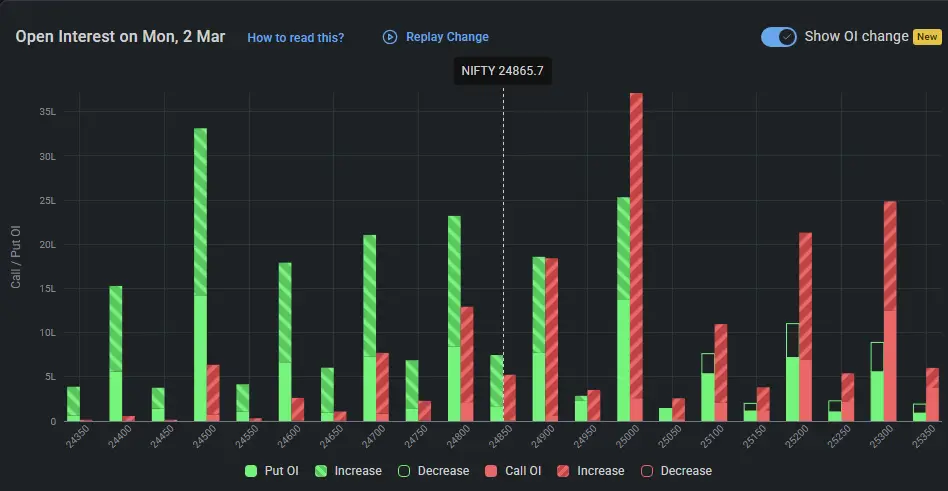
The combined Call and Put OI around at‑the‑money shows that writers are active on both sides, but with a slight tilt towards Call writing at higher strikes, indicating a cautious stance on sustained up‑moves.
The Put‑Call Ratio by OI is hovering close to the neutral zone (around 0.9–1 band), which typically points to a range‑bound to mildly cautious setup rather than outright bullishness.
Max Pain on Nifty options is currently clustered close to the 24,900–25,000 area, suggesting that option sellers would prefer the index to gravitate near this zone into expiry.
In simple terms, option data is signalling that traders see 24,700–24,800 as the “floor” and 24,950–25,200 as the “ceiling” for the immediate term, unless a fresh global trigger pushes markets beyond this band.
Bank Nifty Option Breakdown
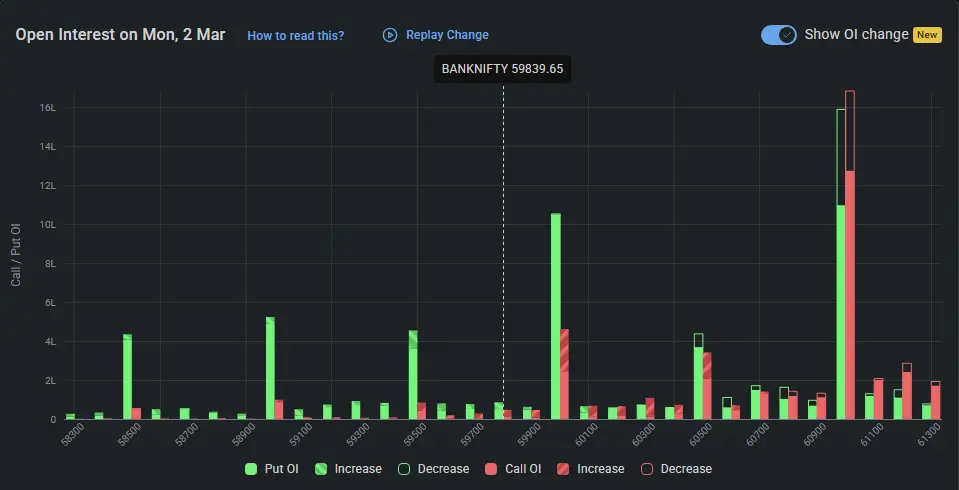
Bank Nifty options with the monthly expiry show concentrated Put OI near the 59,400–59,500 band and heavy Call OI around 60,000 and above, especially near the psychological 60,000 strike.
The Put‑Call Ratio for Bank Nifty is closer to the balanced zone, reflecting that both bullish and bearish bets are present, with a mild bias towards Call writing at resistance.
Max Pain appears closer to the 60,000–61,000 region, indicating that writers expect the index to hover inside this wide band as long as there is no major surprise.
With PCR near equilibrium, consolidation and mean‑reversion strategies may suit better than aggressive trending bets for tomorrow’s session.
Indian Stock Market Prediction for Tomorrow: Key Technical Levels
By combining price action, sector structure and option data, we can build a straightforward technical roadmap for tomorrow’s trade.
Nifty’s recovery from the sub‑24,700 zone and close near 24,865 keeps today’s low as a short‑term reference support, while the unfilled gap and supply zone closer to 24,950–25,000 remain important near‑term resistance.
Bank Nifty’s close around 59,840 after bouncing from sub‑59,300 levels defines 59,300–59,400 as the immediate demand area, with 60,120–60,500 acting as a cap unless strong buying returns.
Nifty & Bank Nifty Key Levels for Tomorrow
| Index | Primary Support | Secondary Support | Primary Resistance | Secondary Resistance |
|---|---|---|---|---|
| Nifty 50 | 24,700 | 24,550–24,500 | 24,950 | 25,100–25,200 |
| Bank Nifty | 59,400 | 59,000 | 60,120 | 60,500–61,000 |
These zones are derived from today’s high‑low range, visible option‑chain clusters and recent swing levels on the daily chart.
A sustained move below Nifty 24,700 can open doors towards the 24,550–24,500 pocket, while a firm break above 24,950–25,000 would be the first sign that bulls are attempting to reclaim lost ground.
In Bank Nifty, holding above 59,400 keeps the structure sideways‑to‑mildly positive, but a close below 59,000 could invite fresh selling pressure towards lower supports.
Indian Stock Market Prediction for Tomorrow: Key Events & Market Drivers
On the global front, traders will be closely tracking headlines around the US–Iran tensions and any impact on crude oil prices, as these have been the primary macro drivers behind the recent risk‑off move in Indian equities.
Overnight moves in US indices and other Asian markets will also play a big role in setting the opening tone, especially if volatility in global risk assets remains elevated.
Domestically, the latest FII/DII activity, rupee movement against the dollar and stock‑specific news around earnings, bulk deals or regulatory updates can create intraday swings even if the indices remain range‑bound.
In the broader calendar, any fresh commentary from major central banks or data releases related to inflation and growth will be monitored for their impact on rate‑cut expectations, which in turn influence flows into emerging markets like India.
For short‑term traders focusing on Tomorrow Market Prediction, staying alert to these macro triggers is essential because they can change intraday sentiment much faster than technical levels alone might suggest.
Indian Stock Market Prediction for Tomorrow: Trading Bias & Important Points
Cautiously Bearish to Range‑Bound
Given the deep gap‑down, partial recovery, and still‑heavy Call writing at nearby resistances, tomorrow’s bias for Nifty and Bank Nifty remains cautiously bearish to range‑bound rather than aggressively bullish.
Nifty is more likely to oscillate between the 24,700–24,750 support band and the 24,950–25,100 resistance zone, while Bank Nifty may trade between 59,400 support and 60,120–60,500 resistance in the absence of strong global cues.
For educational purposes, traders can approach tomorrow as a session where “protect capital first, chase profits later” should guide position sizing and stop‑loss placement.
From a strategy point of view, limited‑risk or hedged option structures, such as credit spreads or defined‑risk iron condors around the mentioned ranges, may suit experienced option sellers who understand adjustments and risk management.
Intraday traders can look for fade‑the‑extremes opportunities near key zones instead of chasing breakouts in the middle of the range, using simple tools like VWAP, previous‑day high‑low and intraday OI shifts as confirmation.
A few important points for Tomorrow Market Prediction from a learning angle:
- Trend Bias: Sideways with a mild downside risk if 24,700 on Nifty or 59,400 on Bank Nifty fails to hold.
- Nifty Focus: Watch 24,700 as a short‑term line in the sand and 24,950–25,100 as a supply pocket; price staying inside this band keeps the consolidation view intact.
- Bank Nifty Focus: As long as 59,400–59,000 holds, sharp follow‑through breakdown is less likely, but failure here may trigger another leg of selling towards lower supports.
- Sector Lens: Defensives like Pharma and selective Metals can continue to show relative strength, while Autos, Energy and Financials may remain choppy or weak if crude and global risk sentiment stay unfavourable.
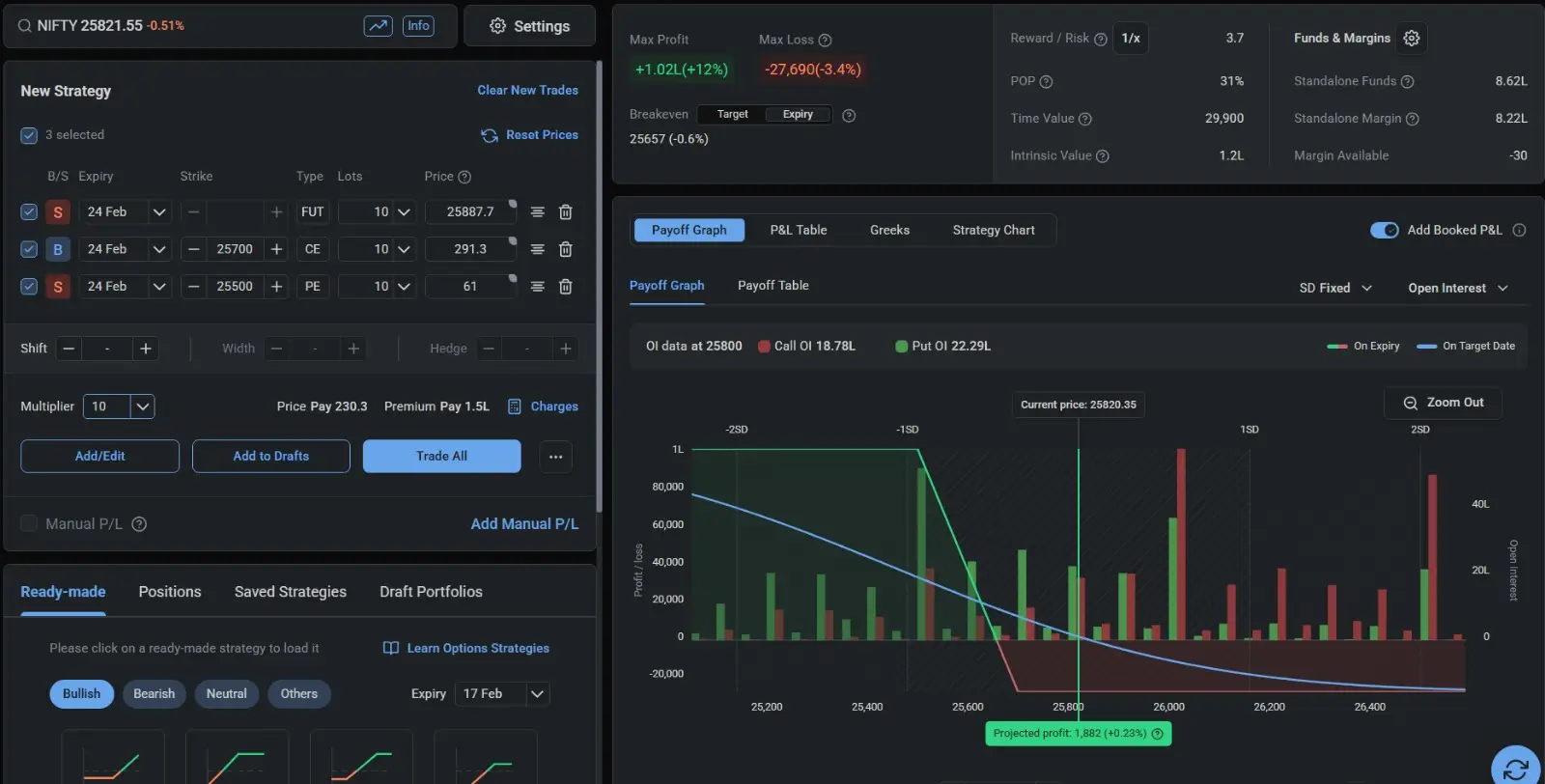
We have created and shared the above strategy in our WhatsApp Community. Click on the button below to join and get these strategies!
Wrapping Up: Your Next Steps with Replete Equities
This Tomorrow Market Prediction for March 3, 2026 highlights how Nifty’s close near 24,865 and Bank Nifty’s finish around 59,840 set up a session dominated by key levels rather than blind trend following.
The combination of global risk, FII selling, domestic support and a neutralish options layout points towards a controlled but volatile range, where disciplined execution and risk management matter more than bold predictions.
Not Sure What to Do Next?
Reading market views is only the first step. What matters is choosing the right approach based on where you are as a trader or investor.
At Replete Equities, we follow a clear, structured path — from learning, to execution, to mastery.
Start Here – Find Your Right PathNo selling. No pressure. Just clarity.
Loved this? Subscribe to Replete Equities for daily updates, join my Option Strategies Mentorship for live sessions on Greeks, OI, and more. Let's build your trading edge together!
What’s your bias for tomorrow? Drop a comment below—I read them all.
Disclaimer: Trading involves risks. Past performance isn't future guarantee. Not investment advice.
Disclaimer
The information and analysis presented above are for educational purposes only and should not be considered investment advice, a solicitation, or an offer to buy or sell securities or financial products. Market investments are inherently risky, and investors must evaluate their own financial situation, risk tolerance, and objectives before making any investment decisions. Past performance does not guarantee future results, and all opinions or projections are subject to change without notice. Readers are strongly advised to consult with their own financial or investment advisors for personalized recommendations. No responsibility or liability is accepted for any losses or damages arising from the use of the information provided herein.


Comments ()