
How Geopolitical Conflicts Impact Options Trading: Managing Volatility During the Iran–Israel Crisis
Learn how geopolitical conflicts increase volatility in options trading and how disciplined risk management helps traders navigate unstable markets.
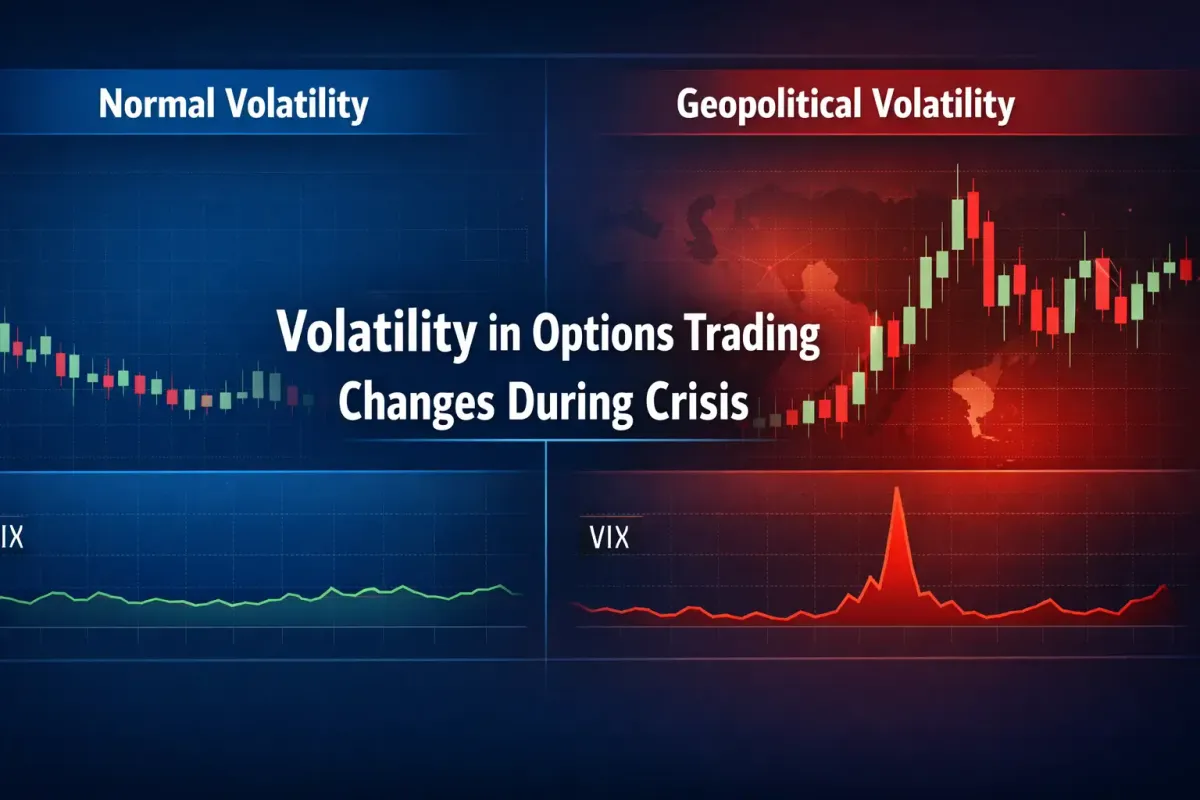
Periods of geopolitical conflict often introduce sudden uncertainty into financial markets. The ongoing tensions between Iran and Israel have led to sharp moves in crude oil, currency markets, global indices, and volatility indicators. For options traders, these environments are not merely directional events — they are volatility events.
When uncertainty rises, implied volatility expands. When implied volatility expands, options pricing changes structurally.
For intermediate traders, this creates both opportunity and elevated risk. Without structured adaptation, high-volatility phases can damage capital faster than anticipated.
This article explains how geopolitical conflicts affect volatility in options trading, how option pricing behaves during such periods, and what disciplined traders do differently to protect capital.
How Geopolitical Conflicts Affect Financial Markets
Geopolitical instability impacts markets through uncertainty channels rather than predictable economic data flows. Unlike scheduled events such as earnings or policy decisions, war-related developments are unpredictable and often escalate rapidly.
Volatility Expansion
When conflict intensifies:
- India VIX and global volatility indices typically rise
- Implied volatility increases across near-term expiries
- Options premiums expand significantly
- Bid-ask spreads widen
Markets price uncertainty immediately. Even before actual price movement occurs, implied volatility often rises as traders hedge risk.
This volatility expansion directly affects options pricing.
Correlation Spikes Across Sectors
During geopolitical stress:
- Indices move in broader correlation
- Sector diversification weakens
- Defensive sectors may temporarily outperform
- Risk assets experience synchronized reactions
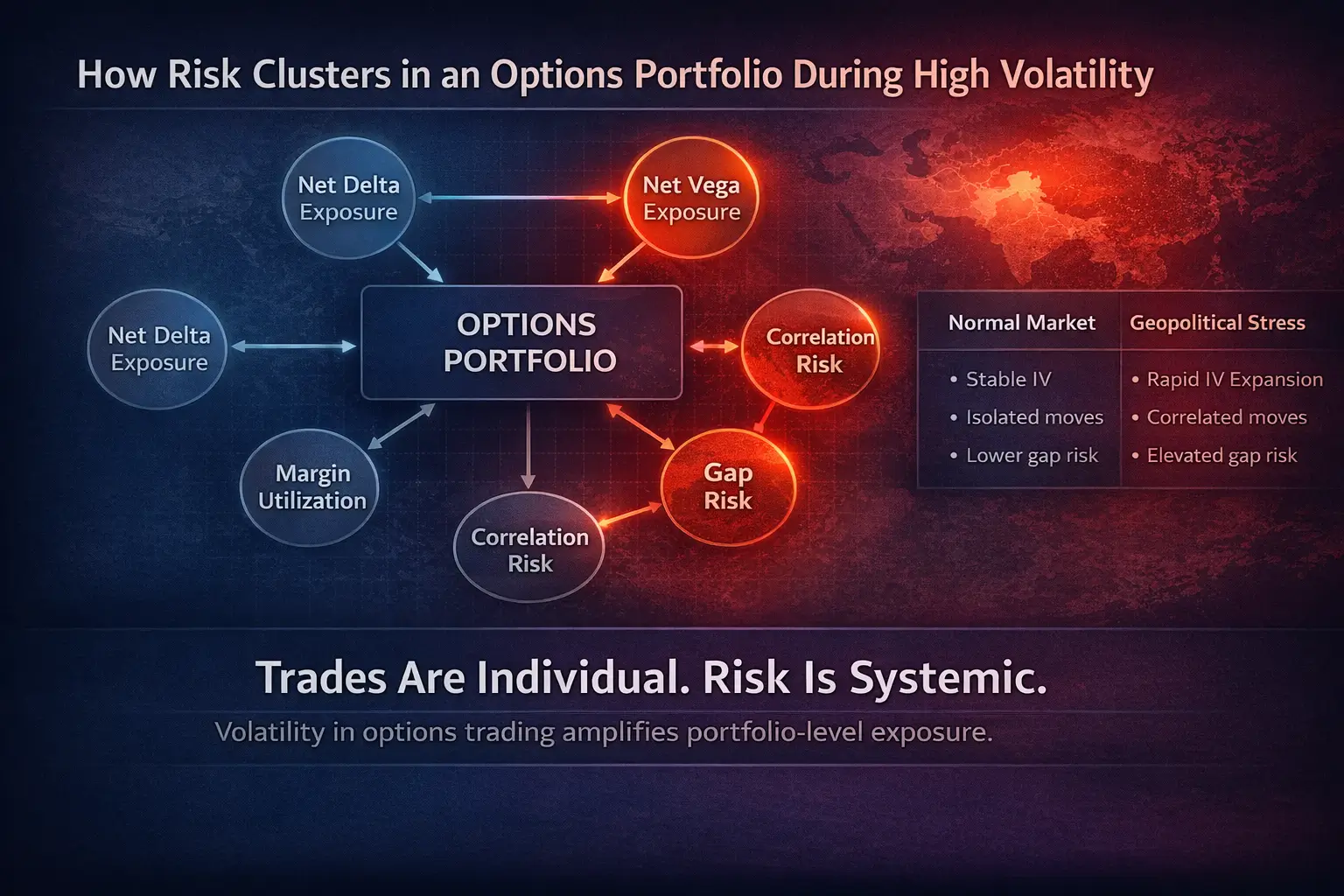
For options traders running multiple positions, this means portfolio-level exposure becomes more concentrated than it appears on the surface.
Diversification assumptions can break down during conflict-driven volatility.
Increased Gap Risk
War-related news frequently emerges outside market hours. As a result:
- Overnight gaps increase
- Pre-market repricing intensifies
- Stop-loss execution becomes less reliable
- Short options face sudden mark-to-market pressure
Gap risk is particularly significant for leveraged options positions without defined risk structures.
What Happens to Options During War-Driven Volatility
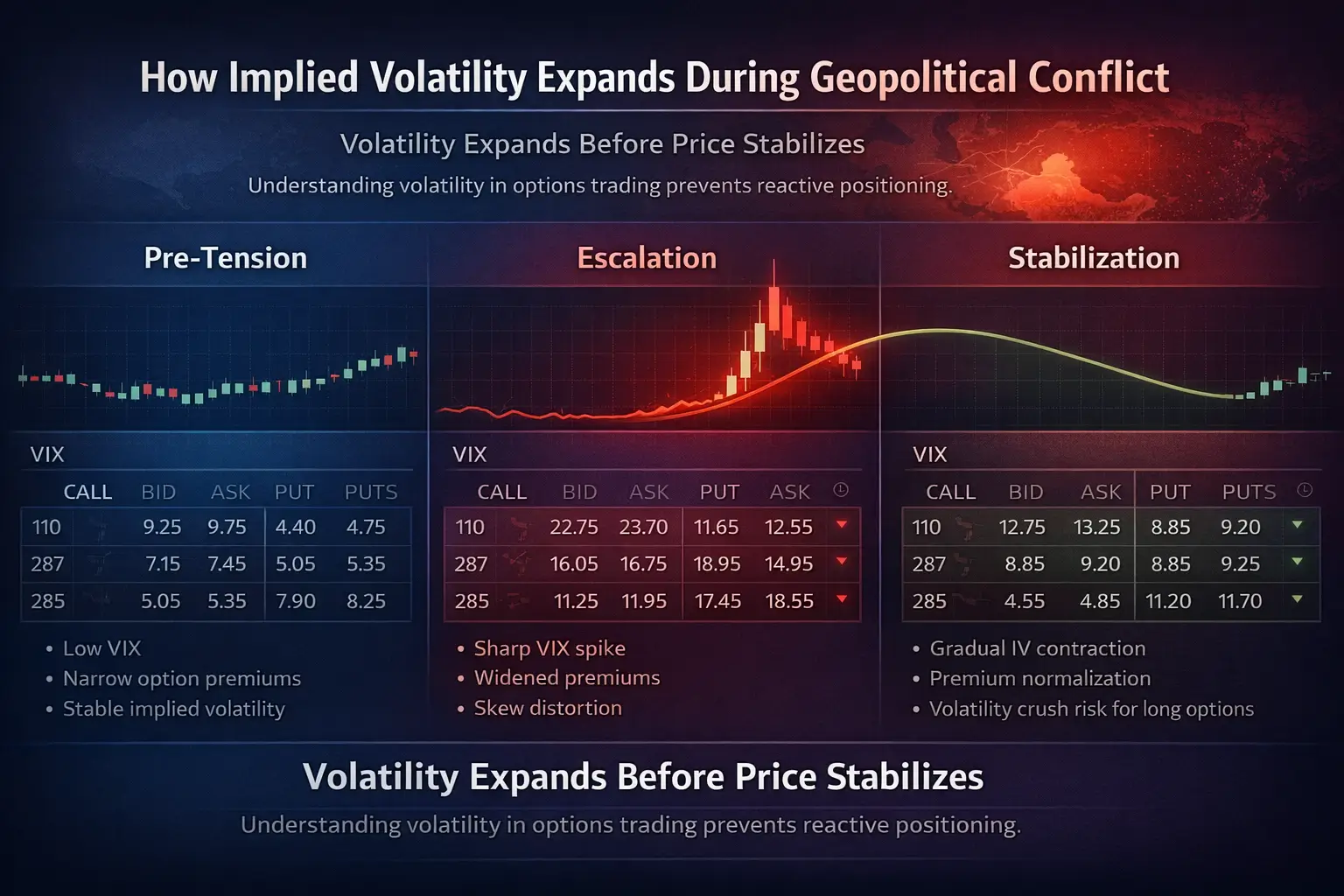
Understanding volatility in options trading requires distinguishing between price movement and volatility expansion.
During geopolitical crises:
- Implied volatility often rises before actual directional moves
- Out-of-the-money options inflate disproportionately
- Vega sensitivity increases across portfolios
- Short premium strategies experience higher stress
Premium Inflation
As uncertainty increases, market participants are willing to pay more for protection. This leads to:
- Higher option premiums
- Expanded volatility skew
- Greater cost for long options
- Increased credit for short options — but with elevated risk
Intermediate traders sometimes misinterpret higher premiums as easier income opportunities. However, inflated premium reflects elevated uncertainty, not guaranteed advantage.
Vega Sensitivity Becomes Central
In high-volatility regimes:
- Small changes in implied volatility create large P&L swings
- Short premium positions become vulnerable to IV expansion
- Long option buyers may face IV crush if tension eases suddenly
The sensitivity of a position to volatility changes (vega) becomes as important as directional exposure (delta).
Without active monitoring, portfolio risk can escalate quickly.
Common Mistakes Traders Make During Crisis Volatility
Periods of geopolitical stress often trigger reactive behavior.
Increasing Size After One Successful High-Volatility Trade
A profitable short premium trade during a volatility spike may create overconfidence. Traders may increase exposure in subsequent trades without recognizing that volatility regimes can shift quickly.
High implied volatility does not eliminate risk. It redistributes it.
Selling Naked Options Aggressively
Elevated premiums tempt traders to sell options without defined risk. However:
- Gamma risk increases near major strikes
- Overnight gaps can exceed collected premium
- Correlation spikes may affect multiple positions simultaneously
Defined-risk spreads provide more structural control than naked exposure during unstable periods.
Buying Options at Peak Implied Volatility
While directional conviction may increase during conflict, buying options when implied volatility is already elevated creates unfavorable entry conditions.
If tensions ease or market stabilizes, implied volatility may contract sharply, leading to losses even if price moves slightly in the anticipated direction.
Ignoring Portfolio-Level Risk
Many traders assess trades individually but fail to examine:
- Net delta exposure
- Net vega concentration
- Margin utilization
- Exposure across correlated instruments
In high-volatility environments, portfolio-level thinking is essential.
Institutional Approach to High Volatility Environments
Professional traders do not attempt to predict geopolitical outcomes. Instead, they adjust exposure relative to uncertainty.
Reduce Position Size
Even if opportunity appears larger, position sizing often decreases during unstable phases. Smaller allocation helps absorb unexpected volatility expansion.
Monitor IV Percentiles
Rather than reacting emotionally, disciplined traders:
- Compare current IV to historical percentiles
- Avoid initiating large short exposure during rapid IV expansion
- Wait for stabilization signals before scaling
Volatility context matters more than directional conviction.
Prefer Defined-Risk Structures
Spreads and hedged positions:
- Limit maximum loss
- Reduce tail-risk exposure
- Provide clearer capital allocation control
In uncertain markets, structural risk containment is more important than maximizing premium collection.
Implement Drawdown Protocols
High-volatility phases demand stricter discipline:
- Predefined maximum daily loss
- Reduced margin caps
- Mandatory trading pauses after threshold drawdowns
- Exposure reduction before major news developments
These controls prevent short-term instability from becoming structural damage.
Should Traders Increase or Decrease Activity During War?
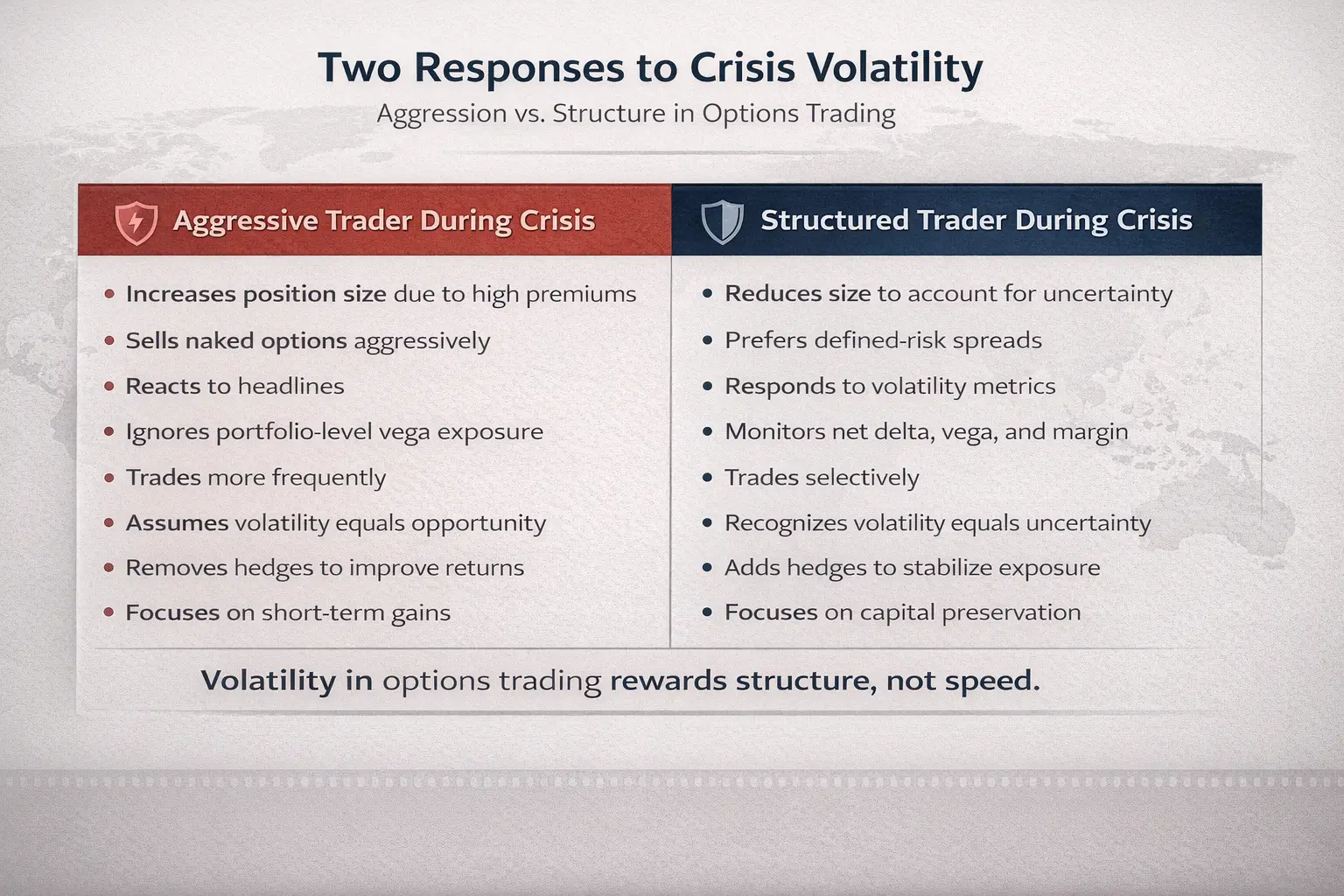
High volatility increases movement and premium, but it also increases uncertainty.
The correct response is not universal expansion or contraction. It depends on:
- Experience level
- Framework robustness
- Portfolio exposure
- Ability to monitor positions actively
For intermediate traders, reducing aggression while maintaining structured engagement is often more sustainable than aggressively scaling exposure.
Volatility in options trading rewards discipline more than speed.
Long-Term Perspective: Volatility Is Cyclical
Geopolitical conflicts create temporary volatility regimes. Markets eventually reprice and stabilize.
Traders who survive these periods:
- Preserve capital
- Maintain structural discipline
- Avoid emotional escalation
- Adapt exposure without abandoning process
The objective is not to maximize returns during crisis.
The objective is to maintain capital integrity through regime transitions.
Summary
The Iran–Israel conflict highlights how geopolitical uncertainty directly impacts volatility in options trading. During such periods:
- Implied volatility expands
- Option premiums inflate
- Correlations increase
- Gap risk rises
- Vega exposure becomes critical
Intermediate traders often make structural mistakes by increasing size, selling naked premium aggressively, or buying options at peak implied volatility.
Professional traders respond differently. They reduce exposure, monitor volatility context, prioritize defined-risk structures, and enforce drawdown protocols.
In unstable markets, capital preservation becomes the primary strategy.
Not Sure What to Do Next?
Reading market views is only the first step. What matters is choosing the right approach based on where you are as a trader or investor.
At Replete Equities, we follow a clear, structured path — from learning, to execution, to mastery.
Start Here – Find Your Right PathNo selling. No pressure. Just clarity.
A Structured Approach to Volatility Management
High-volatility environments test both strategy and discipline. Traders who approach these phases with structured frameworks rather than reactive decisions improve long-term sustainability.
At Replete Equities, the focus remains on process-driven risk management, portfolio-level exposure monitoring, and disciplined capital allocation across volatility regimes.
To deepen your understanding of structured exposure management:
- Explore the Option Strategies Mentorship Program for advanced portfolio risk architecture
- Review the Intraday Option Selling Basket to understand controlled short-premium execution models
- Strengthen foundational principles through the Options Trading Foundations Program
Volatility is unavoidable.
Structured risk management determines whether it becomes an opportunity or damage.

Comments ()