
Trading Isn’t a Strategy Problem. It’s an Alignment Problem.
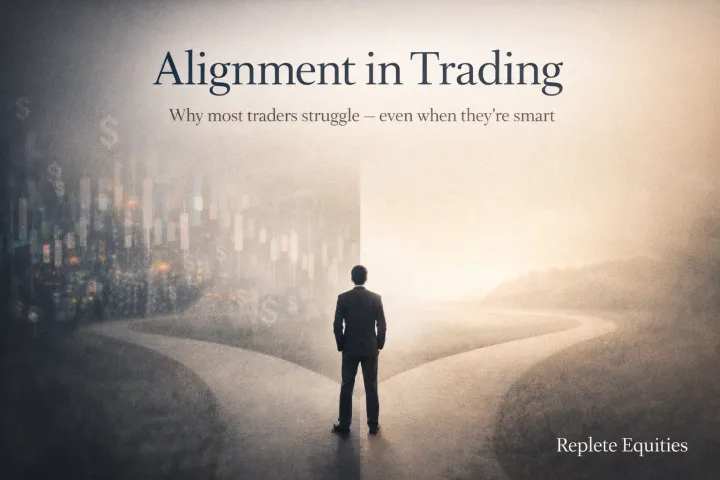
Most traders don’t struggle because of strategies. This conclusion ties together the Alignment in Trading series and explains why clarity comes before action.

Over the last few pieces, we’ve explored a pattern that quietly shows up in almost every trader’s journey.
Not a lack of effort.
Not a lack of intelligence.
Not even a lack of discipline.
But something more subtle.
Misalignment.
What These Three Articles Were Really About
In the first article, we talked about a mistake that rarely gets discussed — confusing emotional comfort with correctness.
How familiar decisions can feel safe, even when they aren’t aligned.
How comfort can quietly replace clarity.
In the second article, we explored why smart, well-read traders often feel stuck.
Not because they don’t know enough — but because what they know doesn’t fit the way they’re trying to participate. Knowledge without fit creates friction. Friction creates fatigue.
In the third article, we zoomed out even further.
Before changing strategies, indicators, or approaches, we asked a deeper question:
Is the problem the strategy — or the role I’m trying to play?
Together, these aren’t three separate problems.
They’re three expressions of the same root issue.
Why This Problem Is So Easy to Miss
Most trading education focuses on what to do.
Very little time is spent on:
- who you are
- how you respond to uncertainty
- how much time and emotional energy you can consistently give
- what kind of feedback you need to stay disciplined
So people default to copying what looks successful.
When it doesn’t feel right, they assume they’re doing something wrong — instead of questioning fit.
Misalignment Doesn’t Look Like Failure
This is important.
Misalignment doesn’t always show up as big losses.
It often shows up as:
- constant second-guessing
- hesitation even when rules are clear
- emotional exhaustion
- repeated strategy changes
- a quiet loss of confidence
From the outside, everything looks “fine”.
From the inside, something feels off.
Why Alignment Changes Everything
When your approach fits you:
- discipline stops feeling forced
- patience becomes possible
- losses feel manageable
- learning integrates naturally
You stop fighting yourself.
And that’s when consistency becomes realistic.
Not exciting.
Not dramatic.
Just sustainable.
A Different Way to Think About Progress
Progress in markets isn’t always about moving forward faster.
Sometimes it’s about pausing long enough to ask:
- Am I playing the right role?
- Does this approach suit my temperament?
- Can I realistically sustain this behaviour across market cycles?
Those answers don’t come from charts.
They come from honest reflection.
Where This Leaves You
If these articles resonated, it doesn’t mean you need to change everything.
It simply means you might benefit from clarity before action.
Clarity about:
- how you participate
- what you should ignore
- and what kind of trader or investor you’re actually built to be
Everything else builds on that.
A final note
I’ve organised the reflections and questions from this series into a short clarity framework called “Which Kind of Trader Are You?”.
It’s not a strategy guide.
It doesn’t offer setups or shortcuts.
It’s simply a structured way to think clearly about alignment before committing more time, money, or emotional energy.
You can find it here: 👇
Read it only if clarity feels more valuable than speed.
Closing Thought
Markets don’t need you to be fearless.
They need you to be honest —
about who you are, how you think, and what kind of uncertainty you can handle consistently.
When that’s clear, the right path tends to reveal itself.
Read it only if clarity feels more valuable than speed.
Author’s Note
I’ve spent years observing traders across different market cycles - not just how they trade, but how they think, react, and adapt when things don’t go as planned.
What stood out wasn’t a lack of intelligence or effort.
It was how often capable people struggled because the way they participated in markets didn’t match who they were.
These articles aren’t meant to provide answers or strategies.
They’re meant to slow the conversation down - just enough to ask better questions.
If any of this resonates, take it as an invitation to reflect, not rush.
Clarity tends to compound better than activity.
- Sachin Sival
Founder, Replete Equities
Writing about market behaviour, alignment, and sustainable decision-making

Comments ()